How To Get Kids Writing Using Frogspawn

No - nothing's coming.

No – nothing’s coming.

Time and time again, I see young kids not wanting to write and teenagers having to write but struggling to get the words down. It’s not just the kids that suffer, staff in schools and colleges have trouble too as they try to get children to produce pieces of writing. This is because of the way the curriculum has gone, it’s all to do with ticking boxes instead of making writing the enjoyable pastime that it is. It is important then to give kids the desire to write while they are young.

If, at this point, you imagine that I’m going to suggest sitting down at a table and getting a workbook out, you can think again. Get some notebooks, pencils and a camera or phone that has a built in camera and get yourself outside.  You’ve heard of a bear hunt – well you are going on a frogspawn hunt.

Gotcha.

Gotcha.

Quick note – it depends what time of the year it is and where you are. The best way to decide what you are looking for is to have a quick look for nature sites on the internet and see what your children are likely to be interested in and if you might find them.  As an example, I will use frogspawn.

So how can finding frogspawn get your children writing?

They can take photos or draw sketches of the places that you looked to find the frogspawn. Underneath the visuals they can write where they went that did not produce any samples and where they found some. I visit a pond daily to get photographs.
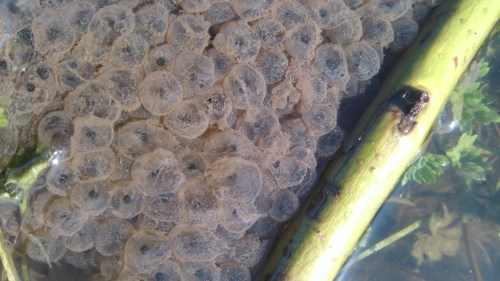
Look what I found.

Look what I found.

After giving them a safety talk about being near water, you can photograph or sketch the frogspawn that you find. You can then either tell your children about the life cycle of the frog or let them research it themselves. They can put all their evidence in their notebooks alongside what they have actually seen.

The next step is for them to imagine the frogspawn going from tadpole to frog. What is he or she called? Once a name has been decided upon and written in the notebook, your child could think about five things that this frog really likes and five things that their frog hates. All this can go down in the notebook as well as a drawing of the fictional frog. I will be doing more posts about story writing at a later date.

I'm called George.

I’m called George.

All of this can be done out in the fresh air and your children can run about and get exercise while getting their notebook together. It is a good idea to encourage your children to take the notebooks on further outings so that they can keep a record of their adventures.

It is important never to criticise the handwriting, grammar or spelling in your children’s notebooks. The reason for this is that the notebook is there for them to express themselves. Handwriting, spelling and grammar will all fall into place if your children learn to love writing.  This will happen if you make writing a natural part of their pleasurable activities.

This website cannot take responsibility for any suggestions that may be followed. It is up to you to keep your children safe.



Leave a comment

Filed under Creative Writing, Exciting Excursions, For children, Help Your Child To Be Sucessful, Parenting

Writing a story – Make Sure That Your Characters Are Dirty Enough

Be whatever you want to be

Writing historical fiction is the closest encounter that you may get with time travel. Therefore, I would urge you to give it a go whether you see yourself as a writer or not.  Why? You may ask. The reason is simple – writing a story  is good for you. When you totally lose yourself in another world you forget outrageous bills; folks that you want to send to Mars and even the state of politics worldwide. It’s your world, you can control it and if you wish to be a gothic temptress or a swash buckling pirate you can be.  in other words, be whatever you want to be.

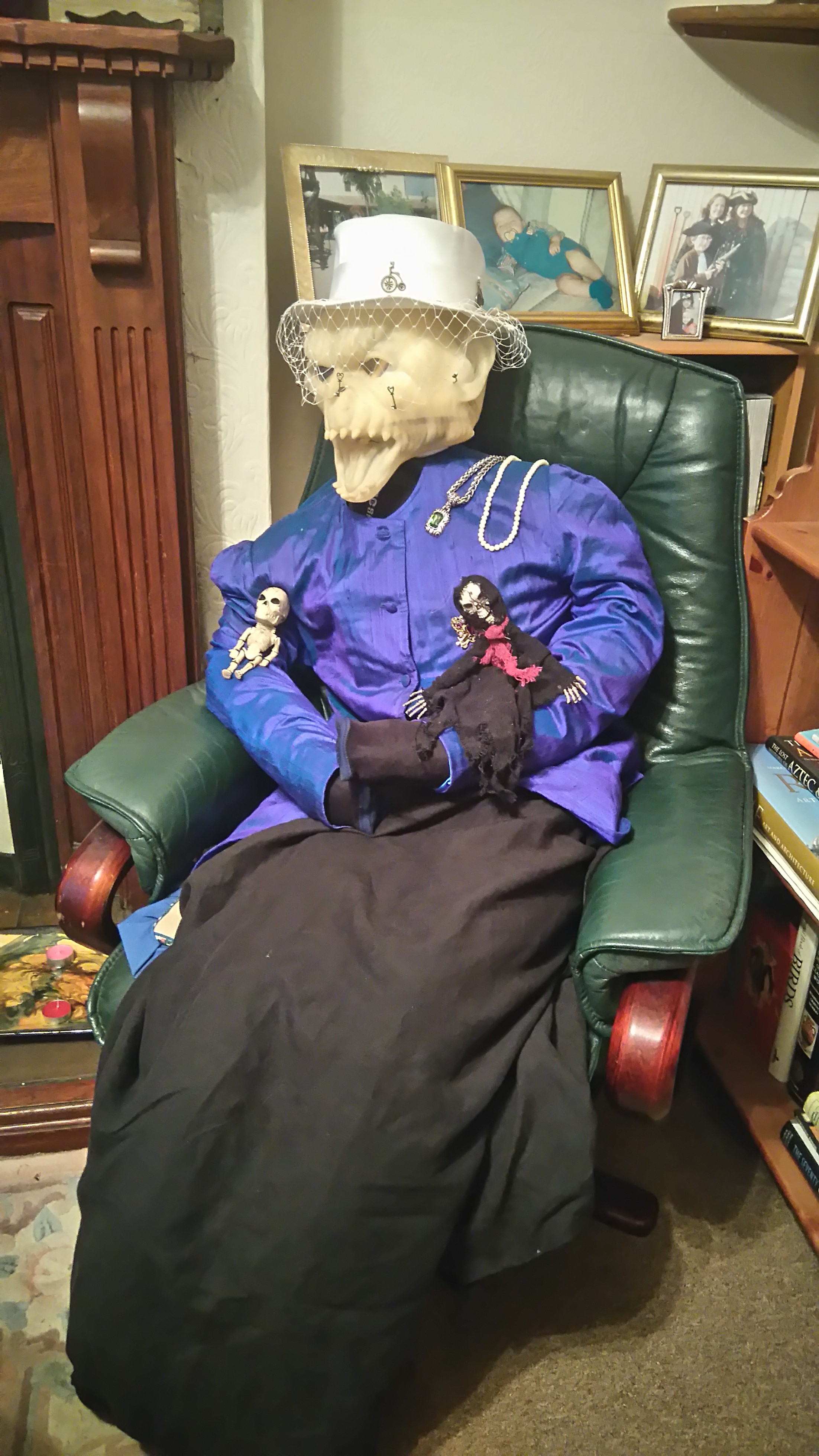
Fancy yourself as a gothic temptress? -Yes, you too could look like this.

Fancy yourself as a gothic temptress? -Yes, you too could look like this.

A word of warning however, don’t go overboard on cleanliness. To give you an idea of how dirty you need to get when you write your stories, I have given you some true examples that I have unearthed.

During the seventeenth century, folks did not favour a good wash all over.  In fact, baths were mostly public places and visited for health purposes as opposed to getting one’s body clean.  For some strange reason, if you did go to the baths to cleanse yourself there was superstition attached to it and it should only be done when the moon was in Libra or Pisces.

Although Samuel Pepys wrote his diary on a regular basis, he did not apply the same amount of drive to washing himself.  He boasted that he sometimes gave himself a vigorous rub down with a cloth which he believed made him clean.  Elizabeth, his wife, however, did visit a public bath house at least once because Samuel sniggered about that too in his diary.

Stay out of my bed, you filthy oaf

Although Elizabeth probably visited the public bath house for health purposes, it would surely have made her smell sweeter than Samuel.  This was what might have put her in a morally advantageous position when she banned him from their shared bed until he had at least ‘cleaned himself with warm water’.  Samuel also had an aversion to washing his feet but he did do it occasionally.  The reason for such behaviour was that flinging off one’s socks and wetting one’s feet could lead to all sorts of health disasters like getting a cold.

Would YOU kick him out of bed?

Would YOU kick him out of bed?

If you’d lived in 1909, you may have been tempted by a newspaper advertisement which suggested that you wash the ‘Witch’ way.  Housewives who had probably been tackling the household wash for years were staunchly advised that they should never rub clothes as that would make the dirt worse.  The secret behind proper clothes washing was simply to let clothes soak in Witch and all the dirt would be loosened out.  This promise was backed up by the boast that that was what clothes manufacturers did and, of course, they all used Witch.  No names were mentioned to back up this testimonial.

“Let your clothes soak overnight in the morning they’ll be white” was the sales slogan.  If you still were not convinced of Witches’ magical washing powers, the manufacturers added that it was a hard soap dried by a secret scientific process and then powdered.  As an added gesture of selling to everyone who read the advertisement, whether scientifically minded or superstitious, there was a huge caricature of a ghastly looking witch on a broomstick on it.  It is really surprising that we are not still using that product today.

Washing clothes is obviously a lot more complicated than can be imagined.  In 1916, a meeting took place of the Camelford Board of Directors for the workhouse to determine if the number of staff could be reduced.  A Mr Boney suggested that they should do their own clothes washing during the war and this would save them the cost of paying a char lady to do it for them.

Me! Wash clothes! Are you insane?

Me! Wash clothes! Are you insane?

Mr Uglow, the Master, stated that he would not wash his own collars; neither would he go without wearing a collar.  When questioned why he would not consider washing his own clothes he wiped his brow and shuddered.  He informed the gathered party that it was out of the question as he had never undergone an apprenticeship to wash clothes.

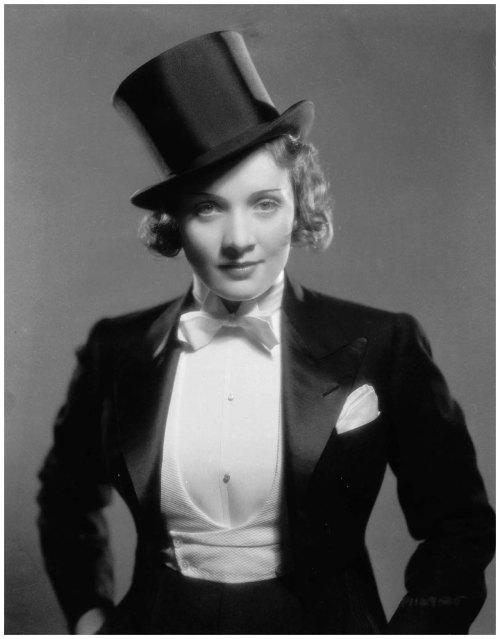
For folks who lived during World War II, food rationing began in 1940 with clothes rationing closely followed in 1941.  Within just eight months, soap rationing meant that having a good soak became something to daydream about.  Even hair washing became a luxury.  Magazines at that time advised their readers to wash greasy hair every ten days but dry hair could go for three weeks before needing a shampoo.  No wonder Marlene Dietrich took three months’ supply of dry shampoo with her when entertaining the troops in Europe.

When you can't get your hands on a shampoo - wear a top hat.

When you can’t get your hands on a shampoo – wear a top hat.

No excuse now – writing a story will help you to get rid of stress and feeling glum because you will be in control. You don’t have to let anyone else read it either – so do yourself a favour, pick up a pen, open a new file or simply record yourself. Happy writing.

18 Comments

Filed under Creative Writing, The Peculiar Past

Scrooge or Sensible? True Thrifty Happenings

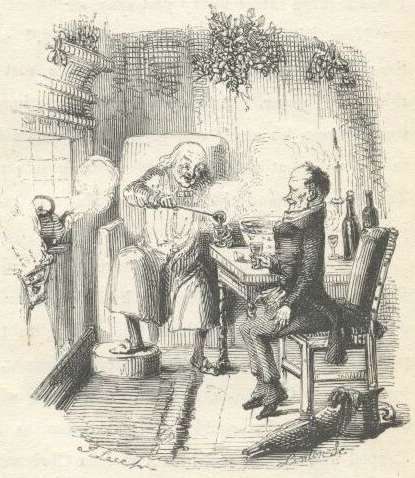
Illustrated by John Leech in 1843.

Illustrated by John Leech in 1843.

How do you view the thrifty? Sensible or like one of Dickens’ most famous characters, Scrooge. Perhaps this will help you to make up your mind.


Thrift For Thought

I first became interested in thrift when my late uncle sagely announced that he never let a grocer weigh the tomatoes until he insisted that the stalks be removed.  If that seems extreme, it soon becomes obvious that it is nothing to what has gone on in the past.

Thrift in the nineteenth century was a well-rehearsed skill from the highest seat of society down to the lowest.  One of the perks of being a ladies’ maid was getting the mistresses’ gowns whilst other unused pieces of cloth would be collected together in a ‘rag-bag’ and household servants would often be allowed to keep these.  They would be passed on to a street buyer, rag and bone man or rag and bottle shop.  Linen would be separated to be sold to a paper manufacturer as paper was made from linen and rag well into the nineteenth century.

Bring out your rags.

Bring out your rags.

Used tea leaves would be utilised to clean carpets and then passed onto cleaning ladies who sold them to dealers.  With a bit of artificial colour thrown in, the dealer would then put the tea leaves (which had been on the carpet) on sale as fresh tea.

Who claims the fat

Each servant appeared to have their own expectations of the booty they could claim and the fat from the roasted animals was earmarked by the cook.  The dripping, as the fat was called, would be used like butter by the poor.

Even bones were sold onto the rag and bone man for fertilizer and household ashes and dust were marketed to help make bricks.  It seems that nothing was thrown away, as soot from chimneys was vended for manure and insect killer.

As people were not aware of how germs were transmitted, it was a regular practise for the very poor to collect dog manure or ‘pure’ as it was politely called.  This was sold to tan yards for the processing of leather for the soft kid gloves so beloved by the rich.

Where there is muck there is brass.

Where there is muck there is brass.

Mrs Child, an American housewife, advised in 1828 that after old coats and pantaloons for boys had been cut up and were no longer capable of being converted into other garments, the housewife should slice them into strips and use the leisure moments of children or domestics in sewing and braiding them into door mats.

Waste is an act of treason

By 1915, thrift in the home was the order of the day.  “Waste is an act of treason when every penny saved helps to save your country.”  This reminder was on the bill announcing the opening of the Patriotic Thrift Exhibition at Hamilton Rooms, Park Street, Bristol 25 – 30th November 1915.  The exhibition was organised by the National Union of Women’s Suffrage Societies who offered a range of lectures on domestic subjects which represent war service in the home.

A familiar theme concerning thrift is that of the wealthy preaching to those less well off.  At the Exeter Society in 1923, the president, Lady Rosalind spoke on women’s extravagance.  She warned of the ‘melancholy spectacle’ of cheap pianos, cheap jewellery and cheap furs bought by women who could not afford them.

During World War II, women found it difficult to get hold of stockings.  Stockings were made of silk as nylon wasn’t invented until 1938 and initially only on sale in America from 1940.  As silk was used to make parachutes for the wartime effort, silk stockings became a rare commodity as both manufacturers and retailers charged high prices and asked for too many clothing coupons for them.

What you have to do.

What you have to do.

Snatched the stockings

In 1944, a bus conductress from Truro found herself in court after being thrifty over silk stockings.  On June 28th, she acquired two pairs from a bus driver without surrendering coupons.  Captain Craze for The Board of Trade snatched the stockings for disposal but they were later seized by the Customs and Excise Department.  Craze opposed this measure saying that he would have to take further instructions from The Board of Trade.  The case was adjourned for a fortnight; thrift can end up causing a lot of expense.

It seems that thrift is here to stay.


12 Comments

Filed under History, The Peculiar Past

6 Great Ways To Cheer Yourself Up This Hallowe’en.

On October 19th, my lovely friend Ross Mountney wrote a post about keeping ourselves cheery during the darker months.  She then asked if anyone had any other ideas for keeping the dark weather grumps at bay. Of course we do. However, they are our own special brand. We hope they raise a smile, if not, please complain to the government, not us, as they are to blame for a lot.

Beauty treatments are a must

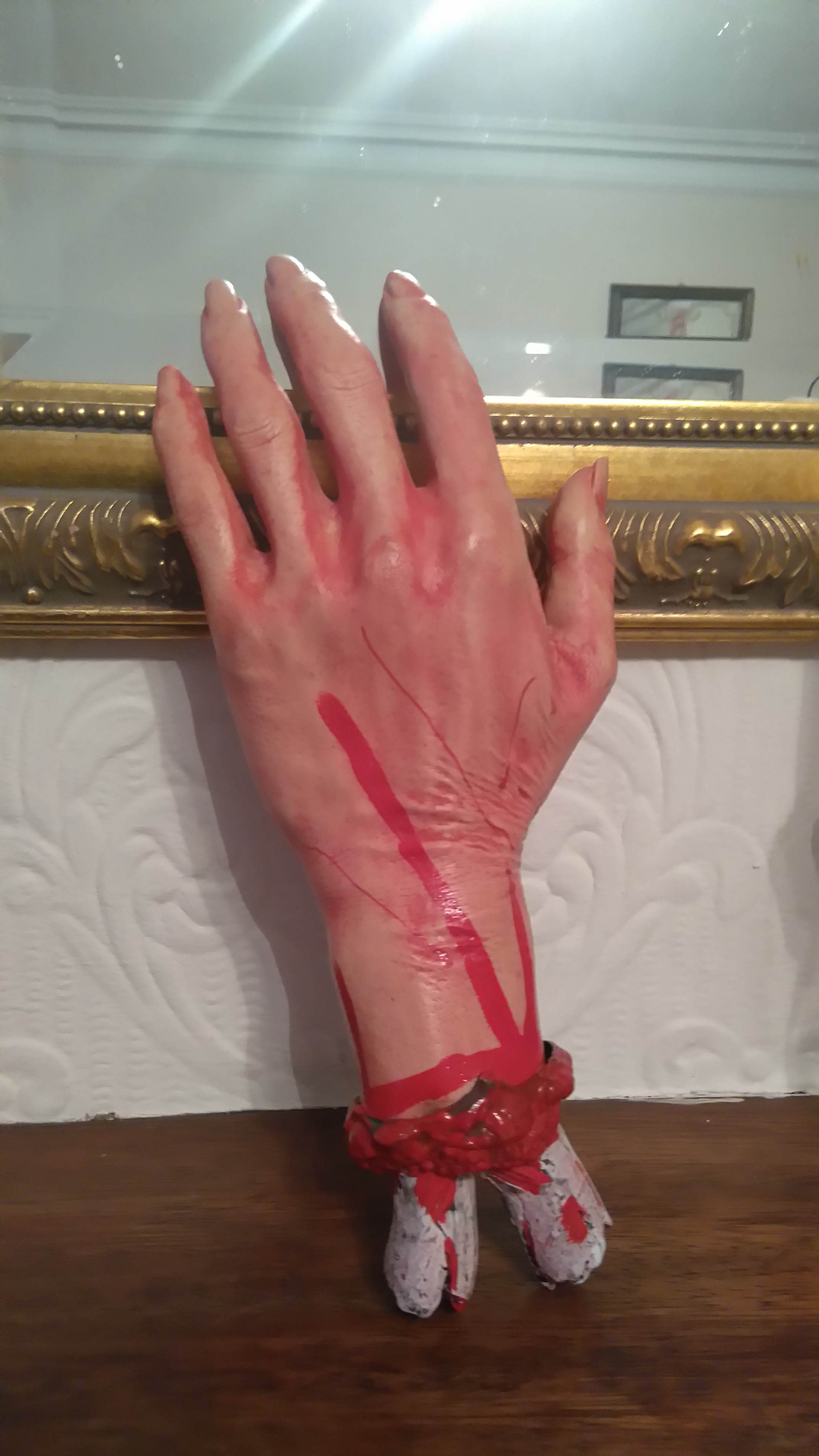
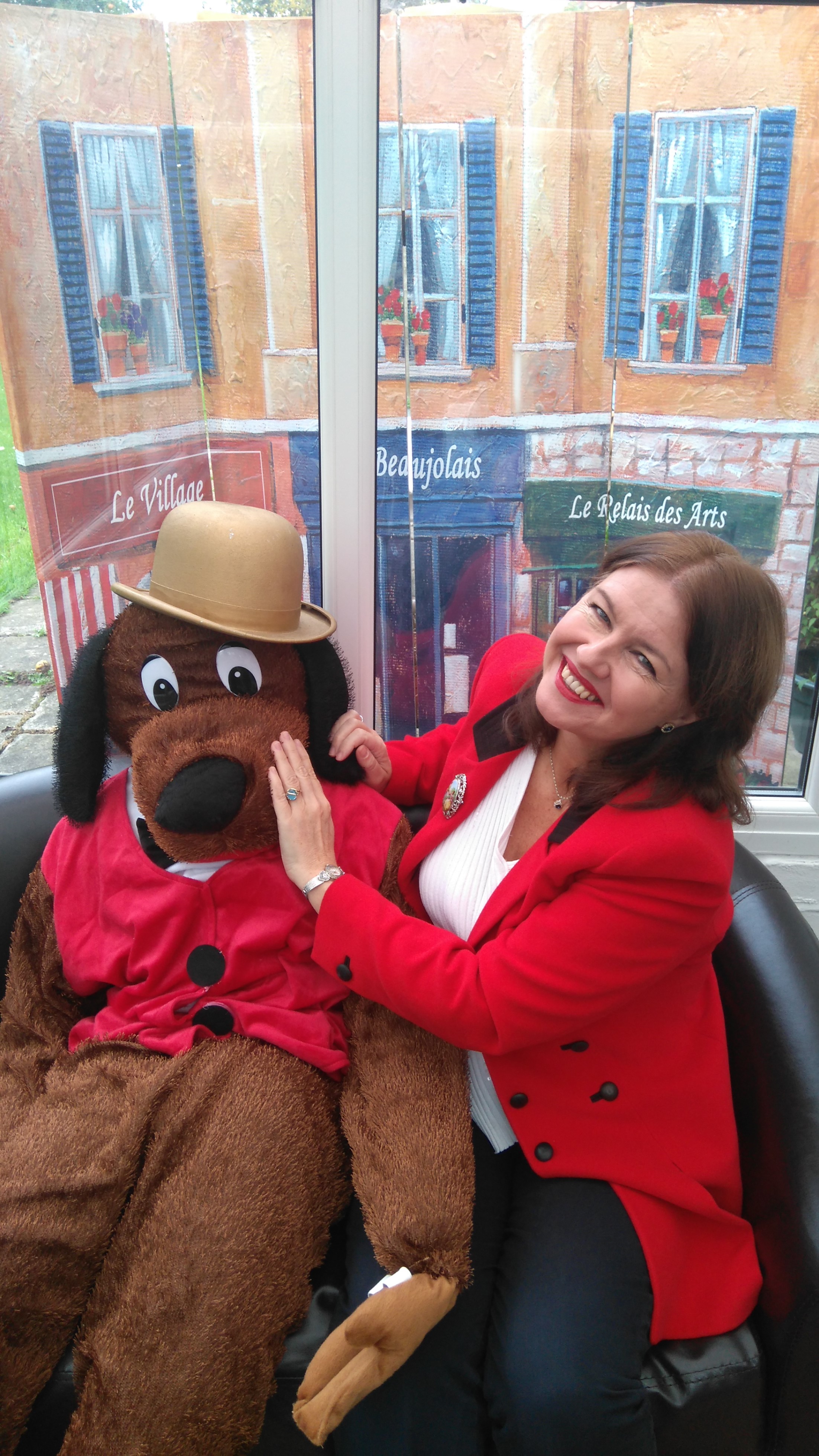
It's imperative that you keep your hands looking good during the colder months.

It’s imperative that you keep your hands looking good during the colder months.

Always dress your best

People visit more during the dark nights so make sure that you are always ready to receive visitors and make an impression.

People visit more during the dark nights so make sure that you are always ready to receive visitors and make an impression.

Keep your home looking cheery and welcoming

A well thought out display can transform a room.

A well thought out display can transform a room.

Read some uplifting literature

A light read will help you to sleep.

A light read will help you to sleep.

Get out to new and interesting places


Graveyards offer stimulating finds like this tree stump bursting with toadstools.

Graveyards offer stimulating finds like this tree stump bursting with toadstools.

Have a hound of a time

Find a suitable friend to keep you happy.

Find a suitable friend to keep you happy.

11 Comments

Filed under Spooky fun

Why we need to get kids into Shakespeare in Primary School

We at Loony Literature headed up to Hull Truck Theatre last week to see the RSC perform The Famous Victories of Henry V – this is a play, for kids, that brings together all the exciting moments of three plays – Henry IV parts I and II and Henry V.

We need more of this

Basically, we need more of this – it is that simple. We have mentioned before that some teenagers can spend more than three years getting a GSCE grade C in English Language which includes a Shakespeare play. This is because they study it for two years at school but if do not get a C or above, they have to do it again.

We have also said to anyone who will listen that kids need to be introduced in a fun manner to Shakespeare in primary school not in secondary school. By the time they study a play at secondary school they need to be relaxed about The Bard. The Famous Victories of Henry V by the RSC was everything and more than we could have wished for.

Simon Yadoo as Sir John Falstaff in The Famous Victories of Henry V. Photo by Richard Lakos.

Simon Yadoo as Sir John Falstaff in The Famous Victories of Henry V. Photo by Richard Lakos.

The cast was made up of young actors apart from the extra talented  Simon Yadoo who played Falstaff/Henry V. The energy of the players was electric as the young actors went among the audience before the play started making sure that they knew what the plot was.

The name of the game at this event was audience participation – those actors worked that audience as if they were back in Elizabethan England. There were props handed out to some of the children and they had to give them to certain characters during the play.

The audience were taught a song about Falstaff’s wine which everyone sang with vigour while waving their arms about. This was obviously a winner as a group of girls sang it loudly in the lavatory after the performance.

A young boy of about eight sat behind us and he had to stand up and shout. He was truly earnest and we were certain that that little boy would never forget that moment all his life. His eyes showed that.

We want them to laugh until their sides ache

The RSC have also taken this production into some schools and we need more of this for our country’s children. Shakespeare is meant to be performed; this is the second item that we need for kids. We need them to experience crafted actors, like Martin Bassindale who played Henry V, bringing the characters to life. We want them to laugh until their sides ache like they did at this production when Mistress Quickly, played by Daniel Abbott, shook his bosom at them.

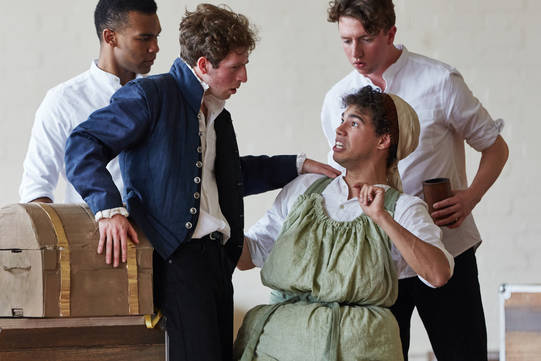
Dale Mathurin as John, Martin Bassindale as Prince Hall, Daniel Abbott as Mistress Quickly and Nicholas Gerard-Martin as Dericke in The Famous Victories of Henry V. Photo by Richard Lakos.

Dale Mathurin as John, Martin Bassindale as Prince Hall, Daniel Abbott as Mistress Quickly and Nicholas Gerard-Martin as Dericke in The Famous Victories of Henry V. Photo by Richard Lakos.

When kids have experienced this they will begin to understand what the Bard is all about. One teacher said that before the RSC visited their school, they used to have the ‘collective groan’ when Shakespeare was mentioned but now there was excitement in the air.

Schools need to go to more theatre trips and more theatre companies need to be working with them, hand in hand. We don’t only want the kids of our country being introduced to Shakespeare in this manner, we want them to see Frankenstein making his monster and Dr Jekyll transforming into Mr Hyde.

We have a world famous literary heritage

As with everything, a major problem is budget. We are not experts on these matters but surely putting money into the problem when kids are in primary school would balance out all those English GSCEs that teenagers are resitting around the country. We are talking hundreds of thousands of resits here, not a mere few.

We have a world famous literary heritage and it is only when we make our kids proud of it will the level of GCSE resits drop.

17 Comments

Filed under Education, Exciting Excursions, Help Your Child To Be Sucessful, Inspiration and Us, Shakespeare Diary, theatre in education

Writing – Make your romance specific

Fancy writing a romance but all you keep coming up with is boy works in office and meets girl? You could try the following exercise to make your romance specific. Take a famous couple from history and write about them. The best way to do this is to research them first so that you know who they are, how they met and what happened to them.

punch-and-judy

You have to fill in the details

If at this point, you think that you would just be writing a piece of history, what you have to remember is that with most peoples’ relationships we only have the bare bones of it no matter how famous they were. This means that when important things happened between them, you have to imagine what went on and fill in the details.

Mary Shelley

For instance, you could write about Mary Shelley and her husband, Percy. Mary is the mother of science fiction because she wrote ‘Frankenstein’ and Shelley is one of our most loved poets. He was also a member of the aristocracy. When we read about their courtship and their life together, it is far more interesting than many novels. Even though we have lots of information on them and their travels we have to fill in what happened when they were alone together and that is where the fiction writer’s imagination comes to life. We have to become Mary when she met Percy and ran away with him. In other words, you can take your own personal feelings and fuse it with historical fact to reach authenticity with your writing.

Happy Writing.

2 Comments

Filed under Creative Writing, Inspiration and Us

Writing – What to do when you’re sick to death of your manuscript

One of the many things that writers have in common is that when they have been working on a manuscript for a while, they get to the stage that just looking at it sends them checking their emails, reading the daily horoscope or making yet another cup of coffee. Sounds familiar? If it doesn’t, this is not for you and what is more, I don’t like you either. (Only joking.)

Girl with typewriter

I really don’t think anything can truly relieve the weary author of manuscriptitis and what is more doctors are truly useless if you approach them with it – I know, I have tried. However, I have three tips that might take a little of the pain away.

Visiting doctor

Put a miserly timer on how long you will work on it. This truly does help. If you think that you will spend all Saturday afternoon editing away, you may find that a huge amount of that time is spent staring at it, looking on Amazon or sending very long emails to your friends. However, if you give yourself one hour a day and when your time is up, you are not allowed to do any more – you will work for an hour. It is amazing how much you can get done in one hour that does not have self-imposed interruptions.

An old clock

Work out exactly what you are going to do before your hour starts. If you are really sick of your manuscript, you can waste an hour wondering what your next step should be. Making a checklist at this stage is vital. So for instance, instead of reading your manuscript yet again and generally just looking over it, you will be looking for something specific. This means that you have one hour only to check that you have enough conflict in each scene or whatever you wish to grind away at. You won’t get through the whole manuscript in one hour but what you do get through will be purely focussed and you can continue with that task in your hourly allotment until you have completed it. Continue in this way working through your checklist.

old manuscript

Work from a printed up copy. There are two reasons why this works. One is that your mind sees it as a change from peering at the computer screen and so welcomes it. It also flings mistakes at you that, for some reason, do not seem so apparent on the screen. This are not just clumsy typos either, you will probably be able to see where you have been telling instead of showing and also how you can elaborate on the senses of your character.

Hope this helps. Happy writing.

8 Comments

Filed under Creative Writing, Inspiration and Us

Writing – Making sure That Your Pongs Stand Out

When we write narrative, it is important that we embrace all the senses. Smell often gets overlooked because it is easy to forget that as our characters go about their adventures that certain whiffs will travel up their snitches whether they like it or not. To get you started, I want you to think about how when we go into public lavatories, we sometimes wrinkle our noses up because someone has been in before us and left a pungent smell or has not flushed properly. Yes, even modern tales have smells in them.

Public Urinals

If you are writing a historical piece, you have won the Lottery because in the Middle Ages virtually everywhere carried an unpleasant odour. Think about it, it must have been totally pongy because most rubbish ended up in the streets. If we drop something down the sides of a bin and it is not noticed, it smells dreadfully within days, multiply that reek by about fifty and you may be near the mark.

Also, if a butcher killed an animal and sold the meat, he would not discreetly and hygienically get rid of the guts, he would fling it out in the street. Over weeks and months of that practise, the smell must have been putrid.

As for the lavatories, well we know that the town council in London passed a law to try to clean up the streets. This was to have public conveniences built over the river Fleet. This meant that people travelling under the bridge, for instance the boatman, had a constant eyeful of bare buttocks and if they were unlucky much more.

Jester

Cor Blimey! I bet there was a whiff under that lot.

Back in the 14th century folks built loos in strange places and it often landed them in court. In 1321, Thomas Wytte and William Hockele were up before the bench for building a toilet in Ebbgate Lane which was supposed to be a public right of way. Apparently, the lavatories projected from the walls of houses so that human waste fell onto the heads of the people who were innocently walking along that stretch of public highway. Mind you, the fact that they were using loos meant that they were the sophisticates of the day, not everyone bothered with them. In fact, many shared rooms with animals and behaved like them.

So get sniffing up while you write, it may produce some results that make you proud.

Happy writing.

Leave a comment

Filed under Creative Writing, History, Inspiration and Us

Writing Historical Fiction – Don’t Drop A Bloomer

If the weather and the government are getting up your pip then you should cheer yourself up with a bit of historical writing. It is pure escapism as you forget the world you live in and adventure into another time. However, beware of making historical bloomers – a typical one is having women wearing knickers too early on.

Fancy a pair of these?

Fancy a pair of these?

Strange though it may seem, up until the late 19th century women did not wear knickers. Yes, knickers are yet another invention of the Victorian era. Of course, they were not called knickers back then but drawers. For a Victorian woman, the drawers would have consisted of two separate knee length legs drawn together with a waistband. This means that her nether regions were left uncovered which is rather bizarre as we tend to think of knickers as a garment which cover those parts which we do not mention.

Initially, the drawers were regarded with hostility. They were viewed as nothing more than an imitation of men’s underclothing. This in itself was offensive to female respectability and virtue. To truly understand this we have to imagine that opinions often came from what the Bible suggested and wearing clothes of the opposite sex was frowned upon.

We also need to understand that the drawers were simply seen as an extra layer and that was associated with prostitution. A prostitute would wear an extra garment so that she could add to her client’s titillation as she had more layers to remove.

On top of that, women in European countries had started wearing drawers. The fact that French women wore them added more resistance against wearing them as the Victorian women thought the French woman was rather fast. If there was one thing a respectable Victorian lady did not want to be viewed as was racy.

Happy writing.

2 Comments

Filed under Creative Writing, History, The Peculiar Past

Help Your Child To Be Successful – A Simple Way To Introduce Shakespeare Early

If you live in some parts of the world, Britain, for instance, your child will have to study Shakespeare to get an English GCSE. It is often problematic, so much so that students resitting the course still cannot engage with the Bard. It is taking some students three years or longer to get a C for English and it upsets me. Three years normally gets you a degree. I’m not saying that is just due to Shakespeare because I know that it is not but it is a part of it.

I’ve said this before and I will not stop saying it, it’s because the groundwork needs to be done when they are little. If your eyes are bulging at this point, I don’t mean that you should get a four year old to deconstruct Hamlet, I mean drip feed it in a fun and exciting fashion.

Start off with Puck from A Midsummer Night’s Dream

  • Puck is often represented as a child – this will instantly allow recognition.
  • Puck can do magic. Small children often feel powerless in a world where they really don’t have much say. They will want to creatively engage with Puck because they can imagine being able to change things.
  • Puck is mischievous – think  Just William and Horrid Henry.

4 fun ways to introduce your child to Puck, a Shakespearean character:

Through drawing

Do your own version.

Do your own version.

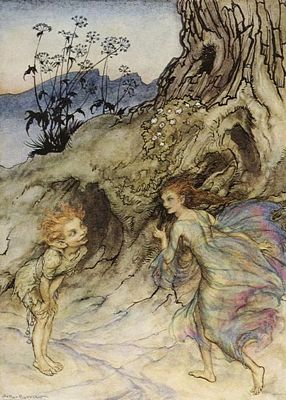
Set up your drawing or art equipment and then show your child the above drawing of Puck by Victorian artist Arthur Rackham. Explain that Puck is a sprite that is in a play for stage called A Midsummer Night’s Dream by a very famous man called William Shakespeare. Don’t forget to mention that he lived about five hundred years ago.

Tell them that Puck is also called Robin Goodfellow and plays naughty tricks in people’s houses and in the woods. Explain that he is also a shapeshifter and transforms himself. Invite your child to draw or paint their own version of him. When they have finished ask them why they have done it like that. How do they view Puck?

Through movement and dance

Make sure that your child is in comfortable clothes and that you have cleared a floor space. Watch this short video of Puck dancing. Ask your child why Puck moves like that in the video – is he trying to send us a secret message without words? Invite your child to copy some of the movements. When you have done that, talk about how they think Puck might move and help them to make up their own dance. You could then film it.

Through drama

Use this quotation from Puck in A Midsummer Night’s Dream – Act III – scene 1 – lines 100 – 106 (Arden)

Through bog, through bush, through brake, through briar;

Sometime a horse I’ll be, sometime a hound,

A hog, a headless bear, sometime a fire;

And neigh, and bark, and grunt, and roar, and burn,

Like horse, hound, hog, bear, fire, at every turn.


Talk about it being in a woodland setting so they would have to act out wading through a bog making sure that they did not sink, fighting scratchy bushes etc… Once they have mastered the landscape, they can imagine that they are Puck and they have to transform themselves into different creatures – what would they be like? How would a hog get through a bog for instance? Again, you could film the end product on your phone.

Through making up a story

It’s important to remember that before children can write stories by themselves, they need to be able to create them; doing this regularly will help your child to be successful at English. Ask your child what they would do if they could be Puck for an afternoon. What would they transform themselves into? Would they play cheeky tricks on others or would they help somebody?

Once you find out what they would really love to do, turn it into a simple story.

  • The beginning is when they find out that they can be Puck for an afternoon.
  • The middle would be the one thing which they would do.
  • The end is the outcome of what they do.

When the story has been worked out, if the child is too young to write – do it for them. There is nothing that will give a child the desire to write more than seeing their own words down on the page.

I hope this helps. Remember even four year olds can be introduced to Shakespeare if it is done simply and gently.

Leave a comment

Filed under Education, For children, Help Your Child To Be Sucessful, Inspiration and Us, Parenting