Tag Archives: creative writing

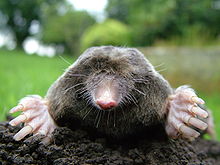
Writing – Are you a butterfly or a mole?

Writing - Are you a butterfly or a mole?

Is it better to flutter from project to project?


At the moment, I am questioning whether I am using the best strategy for my writing career.  I am adopting the butterfly method whereby I flit from children’s fiction to children’s plays to adult fiction.  (By adult fiction, I don’t mean X rated stuff, I simply mean books for adults.  The reason I am explaining this is that I had an embarrassing incident years ago when donating videos to my child’s school fair.  All the ones I had seen donated were videos for children, so I asked if they accepted adult ones – the teaching assistant thought I meant porn and coloured highly when I thrust my “Pride and Prejudice into her hand.)

I am a writing butterfly, I flicker back and forth working on both adult and children’s fiction and I wonder whether I would be more effective if I was a mole, digging and focusing on one tunnel or book until I had reach my goal.

Being a butterfly has its positive aspects in that it keeps the writing schedule fresh and lively.  It also means that if children think my kids’ stuff reeks, their mothers’ might like my physic detective.  In other words, I’m not putting all my eggs into one basket as the old saying goes.

I do feel that being a butterfly has its negative side especially when it comes to marketing.  It means trying to interest two sets of audience, which as any writer knows attracting a single one can be tough going, initially.  It also means that I constantly have more than one plot, setting and set of characters going around in my head which can be like living inside a bee hive at times.

When I talk about being a mole, I must clarify that I mean someone who works on a particular novel but also has a blog and writes articles etc…   I don’t mean that they only work on the novel they are writing at the time and nothing else whatsoever.  The positive side to being a mole is that we can concentrate wholly on the piece we are working on, we might have ideas for future books in our heads but if it is a series with the same main character, it all helps to know this person better.  I think it is the same with marketing, if we are sticking mainly to say writing vampire stories for adults, we can aim all our marketing energy into the one market; the output is far better targeted than that of the butterfly writer.

The negative side to being a mole writer is that the writing atmosphere could become a little staid for the writer after a period of time.  Fundamentally, I think that the main problem is that if the mole concentrates for instance, completely on a series with an alien detective and it flops, the mole needs to start again; obviously, this is not a problem if the series is a hit.

I have to say that as a butterfly writer, I do question whether I would be better off being a mole.  So what are you and is this because you have a strategy or is it because it is the only way for you to write?

Writing - Are you a butterfly or mole?

Being focused hits the spot.

29 Comments

Filed under Creative Writing, Inspiration and Us

Writing – Point of View Problems – What a Palaver!

English: Mulgrave Castle Well worth a visit

English: Mulgrave Castle Well worth a visit (Photo credit: Wikipedia)


At the moment, I am working on a supernatural Victorian novel called Mulgrave Castle.  My main character, Harriet Twine is a young woman who gets dragged mentally and physically into a suspicious murder because she has physic powers which she will not acknowledge.  She is also desperate to find love with the suspicious Dante DeGuise but we will leave bedroom matters for another day.


I am on a major re-write as I initially tried to write it entirely from Harriet’s point of view and then decided that I wanted much more insight into the mysterious DeGuise family of Mulgrave Castle and also wanted more of Jane, Harriet’s paid companion, personal thoughts to come through.  I spent goodness knows how long changing the point of view and then I posted the first few chapters on the loonyliterature website.  The posts have been removed since re-writing started again.


The extracts were extremely well received, the main criticism being that the point of view moved about too much.  As I had already  changed the point of view about once, I decided to completely put the work aside and leave it for a few months and then go back to it.  I find this really helps when I am not sure whether I agree with criticism or not.  It means that the manuscript I am working on has gone cold in my mind and I can look at it with the eyes of others, more than if it is deeply entrenched in my brain through constant working on it.


A strange thing happened before I went back to rereading my last draft of Mulgrave Castle, I was reading Phil Rickman’s book “The Man in The Moss” and found the constant change of point of view really annoying.  I found that I had to stop and think every few pages about whom we were dealing with.  I was further irritated that my two favourite characters, who the back of the book suggested were the main characters, did not feature nearly enough as the point of view seemed so stretched out.  I normally love Phil Rickman’s work, his Merrily Watkin’s books totally transport me but although, I still enjoyed “The Man in The Moss”, I know that if that was the first novel of his that I read, I might not have looked for his other books and been the big fan that I am today.


I reread Mulgrave Castle and decided that the lovely ladies who had given me this critique, Maria Thermann and Ross Mountney were spot on.  It means that I have a huge job of rewriting as over half the novel takes place when Harriet isn’t there.  There are times, at the moment, when I could smack myself around the face with a cold fish for changing the point of view in the first place.  However, maybe if I hadn’t tried it another way, I would never have been truly happy not knowing that I had found the best possible solution to Mulgrave Castle’s point of view.


Has this ever happened to you?  I would really like to know about your experiences of point of view so that when I am banging my head against the laptop at 6a.m. I know that I am not alone.


15 Comments

Filed under Creative Writing, Inspiration and Us, Mulgrave Castle - Harriet Twine the Saucy, Victorian Detective.

Writing – How do you choose a setting?

On our sister site willblyton.com, we’re looking at choosing a setting – any opinions would be appreciated.

Michelle Barber's avatarWill Blyton - The Alternative Detective


At the moment, I am writing a free in between story for our willblyton.com website.  It is called” Will Blyton and The Maggoty Motleys” and I’m being either brave or stupid as the work in progress is being posted.  The Will Blyton books are aimed at 9-12 year olds and explore time travel and will be introducing William Shakespeare and his plays in the books and free stories.


The setting for Will Blyton and The Maggoty Motleys is a children’s literary festival in 2006.  This probably seems like a strange place to set a children’s story but around that time my family were going to a lot of children’s literary festivals and seeing a very mixed bag of children’s writers. This was one of the reasons I felt the urge to set a children’s story at a fictional festival.  Seeing such a range of different…

View original post 427 more words

7 Comments

Filed under About Loony Literature

What sort of writer are you – explorer or planner?

English: Mulgrave Castle. Castle ruins situate...

English: Mulgrave Castle. Castle ruins situated in Mulgrave Woods, near Sandsend on the east coast. (Photo credit: Wikipedia)

At the moment, I am on a major re-write of my supernatural, Victorian novel, “Mulgrave Castle”.  I am having days where I am conjuring up the atmosphere I need to re-create the book in my head and I feel truly satisfied.  However, I am also having days when I will do anything before getting started and then find that I have wasted my writing time.  I am beginning to wonder if this is to do with the type of writer I am.

As I see it, there are basically two types of writers. (Of course, many will be a mixture of the two.)  There is the explorer who has maybe a very basic plot and outline ideas for characters and then lets the whole work evolve as she/he writes.  There is also the planner who has virtually everything worked out either on paper or in their head before they start to write.

I would love to be a planner but my writing muse hates it and I have to accept that I am an explorer.  Being an explorer can be tremendous fun as I sit and type and imagine and all sorts of scenes taking place which help me get to know my characters.  However, it means that I have to do about seven drafts of a book and by drafts I don’t mean spellcheck.  I mean doing a draft purely to re-write the plot, exploring the best point of view, then the same with character development and another one to put signposts in etc…

As I work, I have another file open which is called “Mulgrave Castle Leftovers”, this is basically the cutting room floor.  Being an explorer means that I have scene after scene which is cut because there might only be one relevant sentence in it – however writing these scenes are not a waste of time as they give me an intimate insight into characters and setting.  When we first begin to write, we find it difficult to cut, it is almost as if someone is threatening to cut parts of our person off.  The longer we work at our craft, the more we can see what doesn’t work or what simply is clogging the arteries of the story up.  I call it “boning the text” – basically, I am cutting it down to the bone.  To demonstrate the severity of it, I am on page 63 of my most recent re-write and the “Mulgrave Castle Leftovers” file has 10,000 words in it already.  Goodness knows how many words will be in it by the time I get to the end.

So, I’ve shared with you – now do tell, how do you write?

36 Comments

Filed under Creative Writing, Inspiration and Us, Mulgrave Castle - Harriet Twine the Saucy, Victorian Detective.

Conjuring and Capturing Feelings – Inspiration in Ruins.

English: The Gatehouse at Thornton Abbey

English: The Gatehouse at Thornton Abbey (Photo credit: Wikipedia)

I have great writing days and I have writing days when I simply do not understand why I am writing at all.  On the great ones, I experience life at its best, I know I am not simply alive but actually LIVING, really living as the excitement generates around my body and my fingers flash along the keyboards.  On the bad writing days, I stare at the text and I hate it, every word seems wrong; the characters are cardboard and the plot is boring.  I have trouble concentrating as my mind is more concerned with Bowie songs which will play themselves on a loop in my brain and my study looks like a dusty dump.  At this point, it might seem that on the great days, I get lots of quality writing done and on the bad days, I get nothing done at all.  On the contrary, I still get some done on the bad days, maybe not as much as the good days but the main difference is that it is unpleasant.  To be honest, it puzzled me so much that I started to analyse it to see if I could do anything about it.

I thought about the great days and how they start off and after a while it occurred to me that it is all about feeling certain ways for certain pieces of writing.  For instance, when I work on Mulgrave Castle a supernatural, Victorian novel, I often get a certain feeling coming over me which is my supernatural, Victorian feeling –all it is, is how I felt when I read books and visited places which inspired Mulgrave Castle.  In other words, I had captured the feelings when being inspired to write the book and sometimes they appear when I am actually writing it.  On the bad days, when I would rip it up, if it was on paper, I have not conjured up these feelings and it is jolly hard work.

The more I thought about this, the more it occurred to me that if I could retain the feelings I get when I am inspired and conjure them up at will, my writing and writing experience will greatly benefit from it.  I suppose that really it is merely what Stanislavski suggested  actors should do all those years ago, capture the emotion, store it and learn to bring it back at will.  As I reflected on this, I thought it would be useful if when visiting places to be inspired, I also went with the purpose of capturing the feelings to use again later.  To do this as an experiment, we decided to visit Thornton Abbey in North Lincolnshire as we have used it before for inspiration; I expect though that all ruins will do perfectly well, wherever you are.
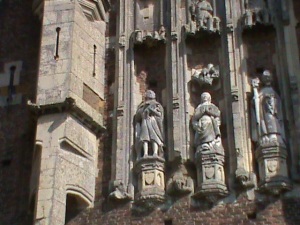
Thornton Abbey

Thornton Abbey

There are some places which one should arrive at preferably by train, Venice being the most obvious example, however, Thornton Abbey in North Lincolnshire is another one.  If you want to feel as if you have gone back to the world of Enid Blyton or “Swallows and Amazons” dump the car at one of the rural villages along the Barton Upon Humber to Cleethorpes railway line and catch the train to Thornton Abbey.

As I chug along through the flat Lincolnshire countryside, I prepare myself for the jump down from the train.  The platform at the Thornton Abbey stop is so old, I literally have to jump off as the platform is way lower than the train.  It is at this point that I start to feel as if I’ve gone back in time.  The beautiful Thornton Abbey Gatehouse beckons in the distance as we make our way along a path which has glorious countryside on either side and big faced, lazy sheep greet us with a glimmer of interest.  The reason I suggest dumping the car and catching the train somewhere along the line is that walking up the path to Thornton Abbey transports me into another world and is a strong source of inspiration when writing children’s adventure stories.  I strongly remember being eleven and long summer holidays; I close my eyes and monitor the feeling, truly noting it and recognising it instead of simply basking in it.  I picture an eleven year old me running down the path towards Thornton Abbey and hold it.  I do a mental click as if I have taken a photograph and hope that I will be able to conjure up this wonderful feeling when the time is right.

We get to the entrance of The Gatehouse and I am really excited as I have been here before and I have to say that it is one of my favourite places to visit.  I am not going to write the history of Thornton Abbey as that is not the point of the piece and there is lots of information on that elsewhere on the internet.

One of the reasons I love visiting Thornton Abbey so much is that it has a wonderful effect on me.  Whenever I visit it, it changes my mood into a very happy, carefree one; the peaceful, happy feelings on the land are so powerful it is like taking a tonic. I intend to capture that strong feeling today, hopefully for use in the future. I have to say at this point that I am well aware that there are stories of Thornton Abbey being haunted by Thomas De Gretham, the 14th abbot of Thornton Abbey,  who was supposed to have been a practitioner of the dark arts and rather partial to the pleasures of the flesh.  He suffered for his crimes in that he was bricked up alive in an underground dungeon and was found still sitting at his desk in the 1830s, hundreds of years later.  There are supposed to have been sightings of him but the only feelings I get from there are happy, beneficial ones which I can use to energise me when I am writing.

Even though Thornton Abbey has a very strong happy aura, it can be used to create feelings for writing spooky stories.  Will and I took picnic rugs and a copy of Edgar Allan Poe’s “The Tell-tale Heart” to Thornton Abbey to read the story amongst the ruins.  We had just finished the story when the sky turned black and we were assaulted with that hard, harsh rain which hurts and soaks within minutes.  We had to shelter in the ruins, which, being ruins, did not really shelter us at all.  It was too far to run to the gatehouse or the small exhibition room so we had to wait and watch the turbulent weather and the swallows flew in and out of our shelter telling us to go – the scene was spooky but made me feel excited.  I closed my eyes and focussed on the image I experienced.  Hopefully, when I remember the scene, the emotions I experienced would return when I want to create that feeling for writing.
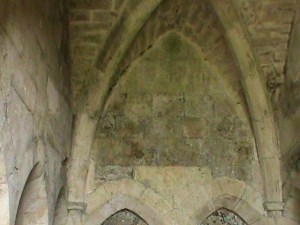
Thornton Abbey

A spooky place to take shelter when there is a storm.

Once the rain stopped, we went to do our final experiment.  We were going to use the main hall on the second floor of the gatehouse for Will to perform a Richard III monologue.  The room was darkly lit with a wooden floor which bends slightly when walked along and shafts of light escape through the gaps up into the room.  It was perfect for Will to perform the villain’s piece and as I watched I shivered and did feel as if I was in another time.  Will took the emotion of how he felt in that room away with him; he really did feel that it was a powerful exercise.
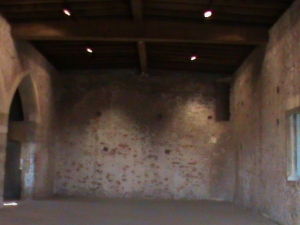
Thornton Abbey

I could really imagine Shakespeare’s Richard III in here plotting.

It might all seem like a great deal of fuss for a bit of writing and acting but it works, not every time because we all have times in our life when it is distraught and we cannot escape reality.  However, because the great moments in life are so precious, we have to create them when and where we can – give it a go when you get the chance or have you been doing it for years? Let me know.

17 Comments

Filed under Creative Writing, Exciting Excursions, Inspiration and Us

Giving Fanny Fear the Finger – Part One!

Conjuring up an image of Fanny Fear is important.

Gosh, that sounds downright rude but unfortunately, that is how we have to behave towards Fanny Fear.  Fanny is short for Frances or Francis, it all depends whether your shoulder blade troll is male or female.  My Fanny Fear is female, she has an extended chin which ends at a point and hunched over shoulders as she is always bent over whispering in my ear with a harsh, hissing voice.  Therefore, I will be referring to Fanny Fear as “she” throughout this post.  However, if you have a male Fanny Fear, please feel free to change the pronoun to “he”.  Fanny Fear infiltrates all aspects of our lives.  However, in this post I want to concentrate on how this shapeshifter stops us from writing, acting, filming or painting.


Let’s start at the beginning.  Fanny Fear will appear in all disguises to actually prevent you from being creative.  Fanny Fear will appear in your mind dressed as your spouse, your school friends, your mother or your work colleagues.  Fanny Fear is an accomplished mistress of disguise.  You’ve been to see a wonderful film or read a book which gave you shivers down your spine.  It has created a spark in your mind, you have an idea for a poem, short story, novel, film or painting.  Hey, this feels good – you feel uplifted, a shadow starts to cover the feeling.  You listen, can you hear something?  You realise it’s the most popular girl/ boy in the school grinning at you in your head.  All the followers appear and they are laughing.  A feeling of darkness blots out your happy, uplifted feeling as you realise they are all mocking your creative work.  Your shoulders hunch and you slump – better not risk it.

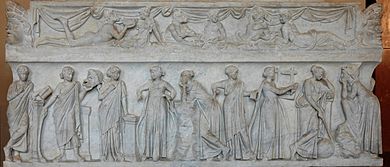
The Nine Muses from Greek mythology. The Sarcophagus at The Louvre.

You get to 45 and are still getting ideas for stories and other creative things – not as many as you used to do because you bat them away like pesky flies.  One day, that creative feeling comes over you again with a renewed strength, it makes you feel good, you want to write your idea down.  You’re a grown up now, you don’t need to worry about your school mates making you look stupid.  You imagine telling your wife/ husband that you’re going to write.  You see them in your head bursting out laughing and saying “what are you wasting your time for, you’ll never get a publisher.”  The dark shadow returns and you give it one last go – you imagine telling your mother.  In your mind, she smiles and says “that’s nice dear – did you get my tablets?”

Okay, that is a worst case scenario with Fanny Fear.  However, I had to do this to point out how Fanny Fear operates.  Fanny Fear is not other people; Fanny Fear is how we imagine other people are going to react concerning our creativity.

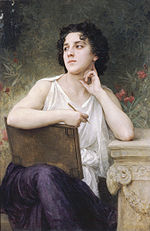
A woman searches for inspiration – William Adolphe Bouguereau.

Fanny Fear feeds on the fear of being mocked.  She sits like a piece of fungus in the back of your mind.  Each time she whispers in your ear and conjures up images in your head and you allow it, she grows and flourishes.  She is the plague of creative people.  The good news is that Fanny Fear can be controlled.

In the first instance, I want you to give Fanny Fear, who might simply be a hissing voice, a pain in your stomach or a dark shadow who looms down on you, a face and body.  It is important that you make Fanny Fear as exaggerated as possible, because that is what she is queen of, exaggeration. Okay, we have this troll fixed in your mind, can you see her?  Take her in, look her over slowly –make sure that you recognise her.  It is important that you attach the look to the dark shadowy feeling, pain in your stomach, or whatever she gives you.  Give her a new name if you like.  That is step one, recognising Fanny Fear, once you have given her a look and a name – if you think of her every time you start imagining people mocking the fact that you are being creative – the horrible feeling which is associated with this instantly lessens.

The next bit becomes easier with awareness.  Be alert because Fanny Fear sneaks up on you at all times.  If you are reading a book and stop to think of the wonderful way with language the writer has; Fanny Fear might quietly whisper “Of course, you will never be able to write like that.”  Stop!  Mentally grab the troll by the ear and face up to it.  Tell the piece of fungus, in your mind, that you are working on your writing and one day will be an accomplished writer.  It then helps to mentally give the creature a swift boot up the backside and imagine it flying through the air.  The more you do this on a regular basis, the less Fanny Fear will visit you.

Once you get Fanny Fear under control – give yourself permission to write, act, film, paint etc…  Tell yourself out loud, write it down.  You have permission to write, act, film or paint.

Okay, so what are you wasting time here for?  Get out there and give Fanny Fear some wellie and then get creating!

Have a wonderful time.

1 Comment

Filed under Creative Writing, For Teens, Inspiration and Us, Self Esteem and Literature

Inspiration and Us – Literature – Your Challenge.

1848 Daguerreotype of Edgar Allan Poe at 39, a...

1848 Daguerreotype of Edgar Allan Poe at 39, a year before his death (Photo credit: Wikipedia)

As humans, we constantly seek connections with other humans and we have always told stories to each other, sometimes simply to make sense of the world around us.  Over the thousands of years, we see the same images emerging again and again.  It is almost as if they are branded in our collective consciousness.  Often, one particular author, artist, actor, composer or film maker does something so spectacular with one of these images that it haunts us until we are creative with it ourselves.  Look into your own creativity and see if you can spot when this has happened to you.


Edgar Allan Poe Museum (Richmond, Virginia)

Edgar Allan Poe Museum (Richmond, Virginia) (Photo credit: Wikipedia)

In my children’s book Will Blyton and The Stinking Shadow, I have an evil shapeshifter called Ravensmite.  He changes from a huge raven into a gothic looking teenage boy at will.  I discussed the use of the raven with a wonderful person and writer, Maria Thermann who also uses ravens in Willow the Vampire and The Sacred Grove.  Maria suggested that we had probably been subconsciously inspired by Edgar Allan Poe’s “The Raven”.  She was absolutely correct.  Edgar Allan Poe had inspired me to create a character, although I had not realised it until Maria pointed it out to me.

Cover for "The Raven" by Edgar Allan...

Cover for “The Raven” by Edgar Allan Poe as illustrated by Gustave Dore (Photo credit: Wikipedia)

The Raven is a narrative poem which has a gothic atmosphere.  A talking raven makes a midnight visit to a mourning lover.   Here is a marvellous video of an animated Poe reciting “The Raven.”  It is done by the very talented poetryreincarnations .


Here’s your challenge – watch the video and use it as a springboard to create something yourself.  Happy writing, acting, painting, composing or filming.


5 Comments

Filed under Creative Writing, For Teens, Inspiration and Us

Inspiration and Us – How Do We Find Our Characters?

As we all know, characters are one of the most fundamental parts of fiction.  This is why we fall in love with a certain series – we are intrigued by the characters.  So where do we conjure up these story people who readers always want to know more about?  I have different methods but in this post I want to demonstrate how sometimes they simply find us.

I had to take my son, Will to rehearsals yesterday for a production he is appearing in next week.  Unfortunately, we had all had the sickness bug and I still felt as if I was on a sailing boat in high winds.  So the thought of hanging around for two hours was not an attractive proposition.  It then occurred to me that I might feel better in the glorious scenery and fresh air of the country park.  What could be more relaxing and uplifting than being surrounded by greenery whilst watching swans floating regally on the lake?

To take away the nausea, I stared at the swans gliding towards me, took deep breaths and imagined medieval music playing in the background.  I was starting to lose my physical discomfort when bounding out of the bushes was a man dressed head to foot in combat gear wielding a weapon.  For a split second, I thought he was after my handbag.  It was a truly uncomfortable moment as there was no-one else around and we were quite a way off from sanctuary.

He rushed past me as if we were in a war zone and he was trying to escape.  I have to tell you at this point that this is a rural, leafy backwater where you have to say hello to every stranger who walks past with their dog.  As I focussed upon him properly, I realised that it wasn’t a weapon he was wielding but one of those huge, phallic type cameras.  He was taking photos of the swans.  I made a quick exit and headed for the visitor centre thinking I would sit inside on one of the benches and gaze at the ducks outside through the walls of glass.

Pair of Wood Ducks

Pair of Wood Ducks (Photo credit: Wikipedia)

After popping yet another boiled sweet into my mouth to take away the nausea, I gazed at a couple of sleeping ducks and suffered envy – true, green, poisonous jealousy.    The jealousy was just on the point of going as I decided I didn’t really want to be a sleeping duck when he appeared again.  He was there aiming his huge camera at the ducks with the aggression and intensity of a hunter.  His camera truly was his rifle.  The ducks looked as if an earthquake at the side of them wouldn’t awaken them, yet he was there breathing heavily ready for action.  It was at this point that his name came to me – he was obviously called Theophile Twitcher.  The ducks slept, he waited and I watched.

After about ten minutes of inactivity, Twitcher heard a noise behind him and he turned around aiming his lethal weapon slowly, like the police do on the television when they rush into a building and don’t know who is hiding there.  Unfortunately, for him, another male duck approached the sleeping duck couple and a duck spat broke out.  Twitcher was too busy searching for lions or bears or whatever with his gun, I mean camera.  He then stalked off.

After popping another boiled sweet into my mouth, I noticed him strutting off into the distance.  I could see a huge, bulging rucksack on his back as he covered every movement and sound with his camera.  He was dressed and equipped as if he was miles away from civilisation.  At this point ,I did wonder if he realised he was in a country park in England.  No doubt, I will never find out but what I did find was a character for my next Will Blyton book.  The seed had been planted, over the next weeks and months this man will turn into a fully formed story person with a back story, personality and problems. I think the children will love him and I’m really looking forward to meeting him.  Have you had any similar experiences?

4 Comments

Filed under Creative Writing, Inspiration and Us

Inspiration and Us – Childhood Books – Shakespeare’s Stories.


Touchstone the Jester from “As You Like It.

Inspiration and us – that’s the name of a new category for the blog.  The reason I am calling it inspiration and us, instead of inspiration and me is because I want you to think about how our lives and our children’s lives inspire us.  I would also be extremely grateful to hear of your inspirational experiences.


As a child, I had many books which I loved but as this is about what inspires us, I shall be mentioning the main sources of inspiration.  One of my favourite books was one which was passed onto me.  I regret to say that I have no idea where it came from.  It was a big book which had many stories in it.  My favourites were some of the stories from Shakespeare’s plays.  They were the plays written in story form with some illustrations.  I read them over and over.  One which sticks in my mind is As You Like It.   It was pure escapism.  The idea of people running away from their everyday lives and living in a forest, appealed to me greatly.  As a child, I loved the idea of dressing up and being in disguise.  Subsequently, when Rosalind dressed up as a boy and pretended to be Ganymede, I was in the story with them.  This is a story which explores sibling rivalry, romance, has a wrestling match and a court jester named Touchstone.  I am proof that the story appeals to children.  If the play had been thrown at me at the age of nine, I would have been put off by its beautiful, poetic language.  However, I was lucky enough to have the plays as stories first and so Shakespeare‘s work was adored by me even before I had read a play or a sonnet.


illustration of William Shakespeare reciting h...

illustration of William Shakespeare reciting his play Hamlet to his family. His wife, Anne Hathaway, is sitting in the chair on the right; his son Hamnet is behind him on the left; his two daughters Susanna and Judith are on the right and left of him. (Photo credit: Wikipedia)


So how has this childhood book inspired me?  First of all, I think the greatest proof is that my son is called Will after Shakespeare.  Incidentally, one of his main ambitions is to play Hamlet at the Globe Theatre.  He has never had Literature forced fed to him.  I was worried that I would do that so I have always been careful and introduced it as the fun, mad and exciting subject that it is.


My educational route would suggest that Shakespeare’s stories also inspired me as I have an Honours Degree in Literature and an M.A. in Creative Writing.  However, I think that the most telling aspect of it is in my writing.  In my children’s book Will Blyton and The Stinking Shadow, I have a small boy trapped in a stone called Hamnet.  He has had a curse put on him by the powerful magician Corspehound.  Not only is Hamnet trapped in the stone but the curse is on his tongue.  He can only insult people.  Hamnet is actually Shakespeare’s son who died at the age of eleven.  The Bubonic Plague was rife at the time.  Little is known about Hamnet and so I wanted to keep his memory alive by re-writing his story.  Instead of perishing before his young life had really begun, I have him living on as a huger than life character.


An illustration of an undertaker during the Bu...

An illustration of an undertaker during the Bubonic plague. (Photo credit: Wikipedia)


I have already written about introducing children to Shakespeare by using insults.  Children love language if they allowed to be playful with it – this is why they love insults – they are naughty and delicious.  This was part of my enjoyment when reading A Midsummer Night’s Dream in my story book.  There was great emphasis on the argument between Hermia and Helena.  It is Midsummer, they are lost in the forest, it is a time of misrule and chaos and they are arguing over men.  Hermia calls Helena – “You juggler! You canker-blossom!” (The Arden Shakespeare – Act III, Scene II Line 282)  Later in the heated argument, Hermia also calls Helena “Thou painted maypole.” (The Arden Shakespeare – Act III, Scene II, Line 296) The enjoyment of the insults as a child turned to inspiration as an adult.  In Will Blyton and The Stinking Shadow, Hamnet is a master of insults; most of them are aimed at Will.  The first thing he ever says to him is “thine intestines wilt be mine.”  This is quickly followed by “thou wilt regret this warty nose.”


Washington Allston's 1818 painting Hermia and ...

Washington Allston's 1818 painting Hermia and Helena. (Photo credit: Wikipedia)


We cannot change our own childhoods.  However, we can be inspired by what was thrown at us and mould it.  As writers, we can turn our experiences into what we want them to be.  Although we cannot change our own childhoods, we can guide our children’s inspiration and education.  Catch them early on with Shakespeare in the form of his stories.  Talk to them about the funny characters like Bottom, from A Midsummer Night’s Dream, who gets the head of an ass for a time.  If you missed out on Shakespeare first time around – you might be surprised at what you find.  Who knows, you or your children might end up being so inspired that you write a book too.


Emil Orlik: Actor Hans Wassmann as Nick Bottom...

Emil Orlik: Actor Hans Wassmann as Nick Bottom in Shakespeare's A Midsummernight's Dream, 1909 (Photo credit: Wikipedia)


15 Comments

Filed under Creative Writing, Education, Inspiration and Us, Parenting

Let’s Talk About FRANKENSTEIN 1

Loony Literature is about being creative with literature.   It is about creative reading as well as creative writing.  As both a lover and graduate of this subject, I positively enjoy deconstructing texts from different points of view – that is what studying literature is about.  It is not about knowing every quotation from Shakespeare as non literary people often assume.  It is about taking a text and analysing and evaluating it whilst backing it all up with textual evidence.  We can add to our arguments by reading the text from a certain perspective e.g. a feminist or a Marxist point of view.  If we enjoy psychoanalytical theory we can use Lacan or even go down a Freudian route.  The possibilities are endless and as long as we can back our argument up with textual evidence, we are free to do this.  There is no right or wrong answer in literature – it is creativity heaven.

Much has been written about Mary Shelley’s Frankenstein; in fact, far too much to mention in this introduction.  I have been using the text as a springboard to write a play and workshops.  However, as all great pieces of fiction tend to do, it has demanded that I read it yet again from a totally different angle.

I love the fact that Frankenstein was written by a teenager.  The other detail about Mary Shelley which sits heavily in my consciousness is that her mother died through complications following her birth.  I am both daughter and mother.  The two relationships are entwined in my being like thread in tapestry.  I feel so much sympathy for Mary Shelley as a young girl growing up with only other people’s stories of her mother.

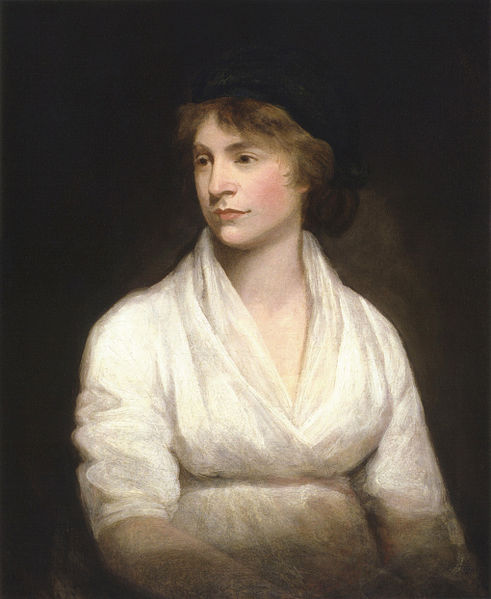
These two facts have made me read Frankenstein again.  I am going to read it as a subconscious cathartic writing exercise for Mary Shelley.  In other words, Shelley wrote herself as Frankenstein.  The monster is her dead mother, Mary Wollstonecraft.  As a teenager, Mary would read on her mother’s grave in St Pancras Churchyard.  The mother was beloved but unobtainable.  It is bad enough as a teenager when your parents do not seem to understand your emotional turmoil.  Mary did not simply have intentionally deaf ears to contend with but dead ears.  Mary needed to find a way to communicate her isolation. I believe that Frankenstein can be read as a letter from Mary Shelley to Mary Wollstonecraft.  How else can an abandoned daughter let her dead mother know what she went through whilst growing up without her?  Fundamentally, as the dead mother was a literary forerunner of her day, there was only one way to get such a mother’s attention and that was to create her own literary masterpiece.  Ironically, Mary Shelley conjured up her own dead mother in the position of abandoned child.

If the monster is supposed to portray her dead mother, why did she make him male?  We all know that women used to constantly die of childbirth in those days; by re-inventing her mother as male, she prevents this taking place.  She needs to keep her mother alive as she lives out the story of isolation Mary felt as a motherless child.

I am at the beginning of this reading of Frankenstein and hope that you will join me on the journey.  I will be making regular posts as I travel on my own new reading journey of Frankenstein.  My model for Frankenstein might not work out.  Ultimately, by offering a hypothesis and then writing a notebook on my reading, I hope that readers of the posts will come up with their own valuable insights.  If this works, I will tackle other delicious texts in the same way.  So let’s talk about Frankenstein.

17 Comments

Filed under Frankenstein, Literary Criticism