If you start an exercise regime, whether it is simply a 15 minute walk a day or a yoga session, and find that after a short while, you give it up, you need to change the way you think about your exercise time.
Looking good.
Most people start exercising because:
It will help them to lose weight
It will lower their blood pressure and cholesterol
It will give them a sexier shape
Other people do it
It will make them fit.
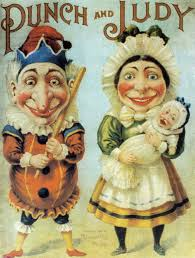
You too can look as sexy as me.
I think that most of us have been there and, after a while, the regular exercise has fallen by the wayside because:
We are too busy
We are exhausted
The weather is awful
We hate it and it stinks
I know about these excuses because I have used them trillions of times. However, when I changed my thoughts about my daily power walk across muddy fields in all weather, my attitude to it changed too.
Instead of doing the walk to help lift my depression and get rid of my back pain, I did it for another reason. I do it because sometimes I feel as if I have no control over my life. I may get rejections for my writing, contracts may end prematurely, editors may ask for changes, the cost of living frightens me to death as my bills go up again and I worry about all the dreadful things that go on in the world but there is not really a lot that I can do about most of it.
When all of these things snowball me, I have to make myself feel that I have some control in my life and that is where the daily power walk comes in. It is up to me whether I do it or not. It’s a simple as that. It’s all about me feeling in control of something.
When you actually tell your subconscious this, it suddenly looks different. It is not about something that you feel that you have to do because it is entirely up to you. So go for it.
On October 19th, my lovely friend Ross Mountney wrote a post about keeping ourselves cheery during the darker months. She then asked if anyone had any other ideas for keeping the dark weather grumps at bay. Of course we do. However, they are our own special brand. We hope they raise a smile, if not, please complain to the government, not us, as they are to blame for a lot.
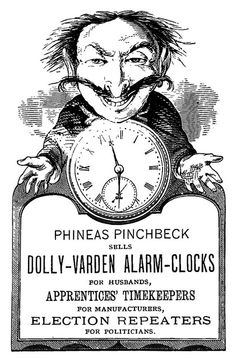
Beauty treatments are a must
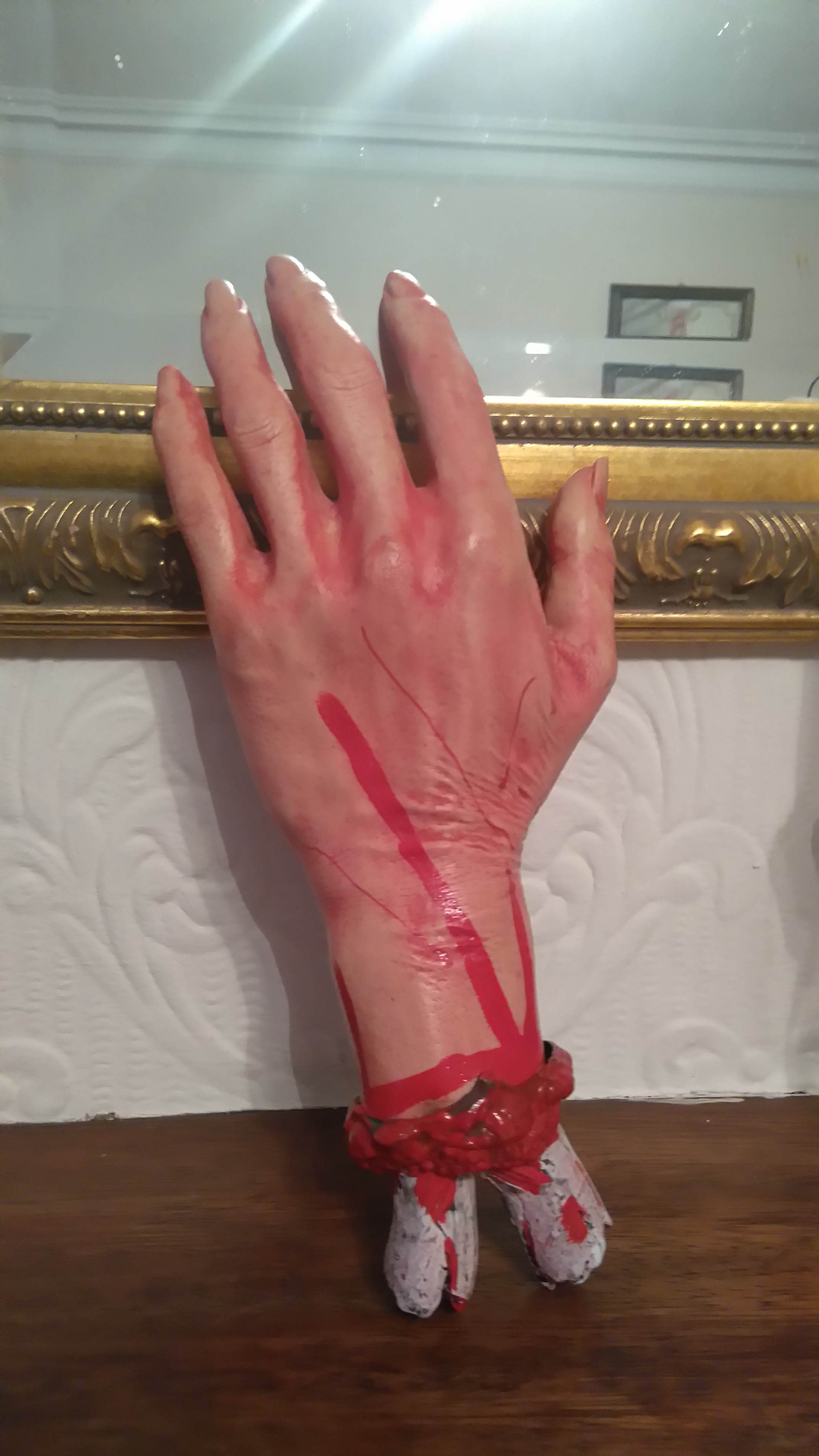
It’s imperative that you keep your hands looking good during the colder months.
Always dress your best
People visit more during the dark nights so make sure that you are always ready to receive visitors and make an impression.
Keep your home looking cheery and welcoming
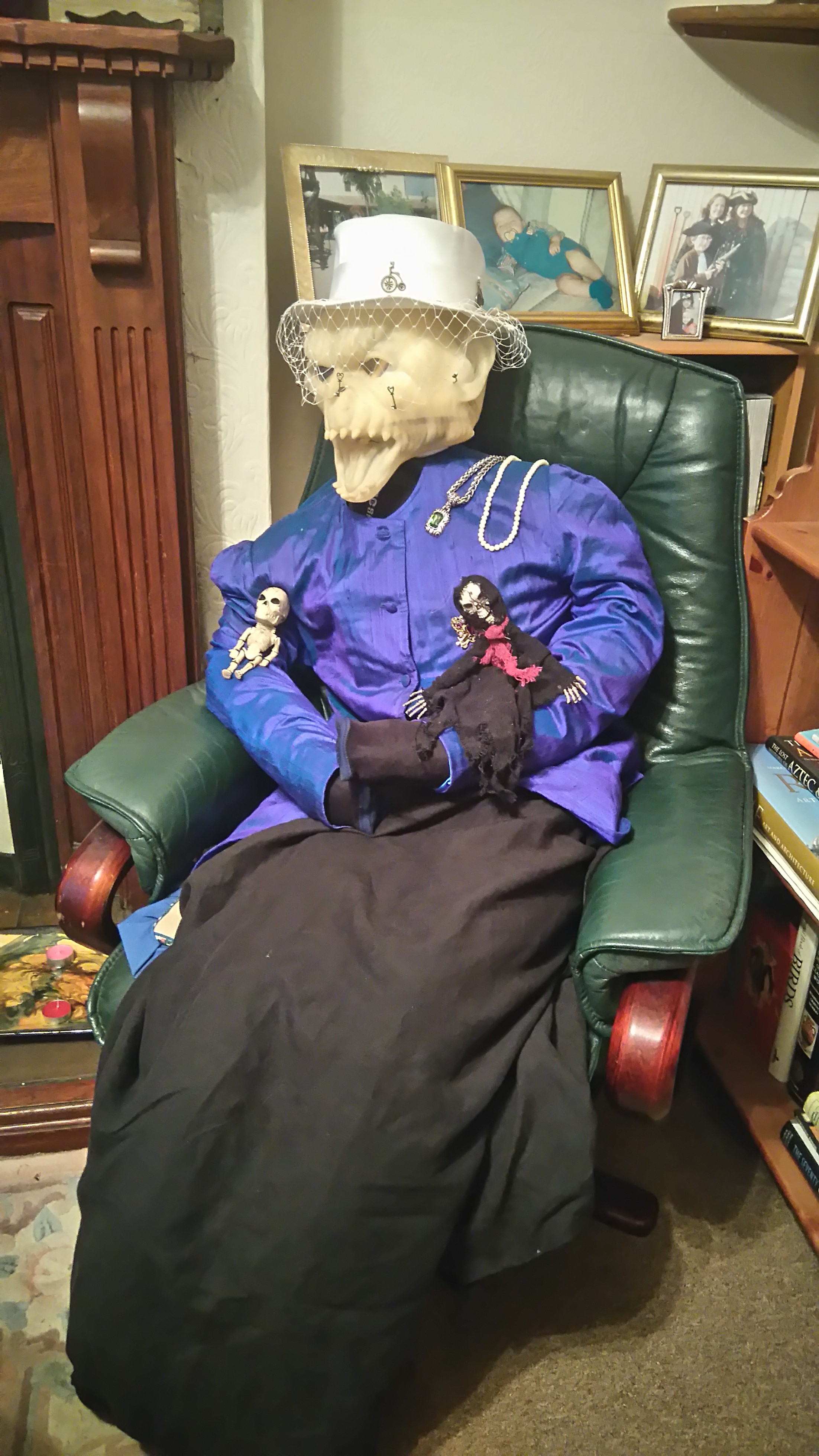
A well thought out display can transform a room.
Read some uplifting literature
A light read will help you to sleep.
Get out to new and interesting places
Graveyards offer stimulating finds like this tree stump bursting with toadstools.
We at Loony Literature headed up to Hull Truck Theatre last week to see the RSC perform The Famous Victories of Henry V – this is a play, for kids, that brings together all the exciting moments of three plays – Henry IV parts I and II and Henry V.
We need more of this
Basically, we need more of this – it is that simple. We have mentioned before that some teenagers can spend more than three years getting a GSCE grade C in English Language which includes a Shakespeare play. This is because they study it for two years at school but if do not get a C or above, they have to do it again.
We have also said to anyone who will listen that kids need to be introduced in a fun manner to Shakespeare in primary school not in secondary school. By the time they study a play at secondary school they need to be relaxed about The Bard. The Famous Victories of Henry V by the RSC was everything and more than we could have wished for.
Simon Yadoo as Sir John Falstaff in The Famous Victories of Henry V. Photo by Richard Lakos.
The cast was made up of young actors apart from the extra talented Simon Yadoo who played Falstaff/Henry V. The energy of the players was electric as the young actors went among the audience before the play started making sure that they knew what the plotwas.
The name of the game at this event was audience participation – those actors worked that audience as if they were back in Elizabethan England. There were props handed out to some of the children and they had to give them to certain characters during the play.
The audience were taught a song about Falstaff’s wine which everyone sang with vigour while waving their arms about. This was obviously a winner as a group of girls sang it loudly in the lavatory after the performance.
A young boy of about eight sat behind us and he had to stand up and shout. He was truly earnest and we were certain that that little boy would never forget that moment all his life. His eyes showed that.
We want them to laugh until their sides ache
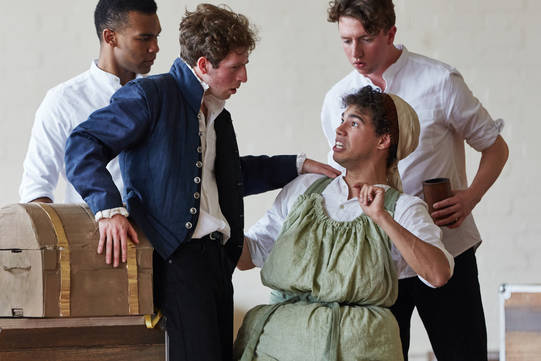
The RSC have also taken this production into some schools and we need more of this for our country’s children. Shakespeare is meant to be performed; this is the second item that we need for kids. We need them to experience crafted actors, like Martin Bassindale who played Henry V, bringing the characters to life. We want them to laugh until their sides ache like they did at this production when Mistress Quickly, played by Daniel Abbott, shook his bosom at them.
Dale Mathurin as John, Martin Bassindale as Prince Hall, Daniel Abbott as Mistress Quickly and Nicholas Gerard-Martin as Dericke in The Famous Victories of Henry V. Photo by Richard Lakos.
When kids have experienced this they will begin to understand what the Bard is all about. One teacher said that before the RSC visited their school, they used to have the ‘collective groan’ when Shakespeare was mentioned but now there was excitement in the air.
Schools need to go to more theatre trips and more theatre companies need to be working with them, hand in hand. We don’t only want the kids of our country being introduced to Shakespeare in this manner, we want them to see Frankenstein making his monster and Dr Jekyll transforming into Mr Hyde.
We have a world famous literary heritage
As with everything, a major problem is budget. We are not experts on these matters but surely putting money into the problem when kids are in primary school would balance out all those English GSCEs that teenagers are resitting around the country. We are talking hundreds of thousands of resits here, not a mere few.
We have a world famous literary heritage and it is only when we make our kids proud of it will the level of GCSE resits drop.
Fancy writing a romance but all you keep coming up with is boy works in office and meets girl? You could try the following exercise to make your romance specific. Take a famous couple from history and write about them. The best way to do this is to research them first so that you know who they are, how they met and what happened to them.
You have to fill in the details
If at this point, you think that you would just be writing a piece of history, what you have to remember is that with most peoples’ relationships we only have the bare bones of it no matter how famous they were. This means that when important things happened between them, you have to imagine what went on and fill in the details.
For instance, you could write about Mary Shelley and her husband, Percy. Mary is the mother of science fiction because she wrote ‘Frankenstein’ and Shelley is one of our most loved poets. He was also a member of the aristocracy. When we read about their courtship and their life together, it is far more interesting than many novels. Even though we have lots of information on them and their travels we have to fill in what happened when they were alone together and that is where the fiction writer’s imagination comes to life. We have to become Mary when she met Percy and ran away with him. In other words, you can take your own personal feelings and fuse it with historical fact to reach authenticity with your writing.
One of the many things that writers have in common is that when they have been working on a manuscript for a while, they get to the stage that just looking at it sends them checking their emails, reading the daily horoscope or making yet another cup of coffee. Sounds familiar? If it doesn’t, this is not for you and what is more, I don’t like you either. (Only joking.)
I really don’t think anything can truly relieve the weary author of manuscriptitis and what is more doctors are truly useless if you approach them with it – I know, I have tried. However, I have three tips that might take a little of the pain away.
Put a miserly timer on how long you will work on it. This truly does help. If you think that you will spend all Saturday afternoon editing away, you may find that a huge amount of that time is spent staring at it, looking on Amazon or sending very long emails to your friends. However, if you give yourself one hour a day and when your time is up, you are not allowed to do any more – you will work for an hour. It is amazing how much you can get done in one hour that does not have self-imposed interruptions.
Work out exactly what you are going to do before your hour starts. If you are really sick of your manuscript, you can waste an hour wondering what your next step should be. Making a checklist at this stage is vital. So for instance, instead of reading your manuscript yet again and generally just looking over it, you will be looking for something specific. This means that you have one hour only to check that you have enough conflict in each scene or whatever you wish to grind away at. You won’t get through the whole manuscript in one hour but what you do get through will be purely focussed and you can continue with that task in your hourly allotment until you have completed it. Continue in this way working through your checklist.
Work from a printed up copy. There are two reasons why this works. One is that your mind sees it as a change from peering at the computer screen and so welcomes it. It also flings mistakes at you that, for some reason, do not seem so apparent on the screen. This are not just clumsy typos either, you will probably be able to see where you have been telling instead of showing and also how you can elaborate on the senses of your character.
When we write narrative, it is important that we embrace all the senses. Smell often gets overlooked because it is easy to forget that as our characters go about their adventures that certain whiffs will travel up their snitches whether they like it or not. To get you started, I want you to think about how when we go into public lavatories, we sometimes wrinkle our noses up because someone has been in before us and left a pungent smell or has not flushed properly. Yes, even modern tales have smells in them.
If you are writing a historical piece, you have won the Lottery because in the Middle Ages virtually everywhere carried an unpleasant odour. Think about it, it must have been totally pongy because most rubbish ended up in the streets. If we drop something down the sides of a bin and it is not noticed, it smells dreadfully within days, multiply that reek by about fifty and you may be near the mark.
Also, if a butcher killed an animal and sold the meat, he would not discreetly and hygienically get rid of the guts, he would fling it out in the street. Over weeks and months of that practise, the smell must have been putrid.
As for the lavatories, well we know that the town council in London passed a law to try to clean up the streets. This was to have public conveniences built over the river Fleet. This meant that people travelling under the bridge, for instance the boatman, had a constant eyeful of bare buttocks and if they were unlucky much more.
Cor Blimey! I bet there was a whiff under that lot.
Back in the 14th century folks built loos in strange places and it often landed them in court. In 1321, Thomas Wytte and William Hockele were up before the bench for building a toilet in Ebbgate Lane which was supposed to be a public right of way. Apparently, the lavatories projected from the walls of houses so that human waste fell onto the heads of the people who were innocently walking along that stretch of public highway. Mind you, the fact that they were using loos meant that they were the sophisticates of the day, not everyone bothered with them. In fact, many shared rooms with animals and behaved like them.
So get sniffing up while you write, it may produce some results that make you proud.
If the weather and the government are getting up your pip then you should cheer yourself up with a bit of historical writing. It is pure escapism as you forget the world you live in and adventure into another time. However, beware of making historical bloomers – a typical one is having women wearing knickers too early on.
Fancy a pair of these?
Strange though it may seem, up until the late 19th century women did not wear knickers. Yes, knickers are yet another invention of the Victorian era. Of course, they were not called knickers back then but drawers. For a Victorian woman, the drawers would have consisted of two separate knee length legs drawn together with a waistband. This means that her nether regions were left uncovered which is rather bizarre as we tend to think of knickers as a garment which cover those parts which we do not mention.
Initially, the drawers were regarded with hostility. They were viewed as nothing more than an imitation of men’s underclothing. This in itself was offensive to female respectability and virtue. To truly understand this we have to imagine that opinions often came from what the Bible suggested and wearing clothes of the opposite sex was frowned upon.
We also need to understand that the drawers were simply seen as an extra layer and that was associated with prostitution. A prostitute would wear an extra garment so that she could add to her client’s titillation as she had more layers to remove.
On top of that, women in European countries had started wearing drawers. The fact that French women wore them added more resistance against wearing them as the Victorian women thought the French woman was rather fast. If there was one thing a respectable Victorian lady did not want to be viewed as was racy.
If you live in some parts of the world, Britain, for instance, your child will have to study Shakespeare to get an English GCSE. It is often problematic, so much so that students resitting the course still cannot engage with the Bard. It is taking some students three years or longer to get a C for English and it upsets me. Three years normally gets you a degree. I’m not saying that is just due to Shakespeare because I know that it is not but it is a part of it.
I’ve said this before and I will not stop saying it, it’s because the groundwork needs to be done when they are little. If your eyes are bulging at this point, I don’t mean that you should get a four year old to deconstruct Hamlet, I mean drip feed it in a fun and exciting fashion.
Start off with Puck from A Midsummer Night’s Dream
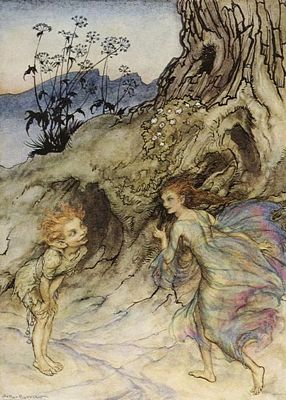
Puck is often represented as a child – this will instantly allow recognition.
Puck can do magic. Small children often feel powerless in a world where they really don’t have much say. They will want to creatively engage with Puck because they can imagine being able to change things.
Puck is mischievous – think Just William and Horrid Henry.
4 fun ways to introduce your child to Puck, a Shakespearean character:
Through drawing
Do your own version.
Set up your drawing or art equipment and then show your child the above drawing of Puck by Victorian artist Arthur Rackham. Explain that Puck is a sprite that is in a play for stage called A Midsummer Night’s Dream by a very famous man called William Shakespeare. Don’t forget to mention that he lived about five hundred years ago.
Tell them that Puck is also called Robin Goodfellow and plays naughty tricks in people’s houses and in the woods. Explain that he is also a shapeshifter and transforms himself. Invite your child to draw or paint their own version of him. When they have finished ask them why they have done it like that. How do they view Puck?
Through movement and dance
Make sure that your child is in comfortable clothes and that you have cleared a floor space. Watch this short video of Puck dancing. Ask your child why Puck moves like that in the video – is he trying to send us a secret message without words? Invite your child to copy some of the movements. When you have done that, talk about how they think Puck might move and help them to make up their own dance. You could then film it.
Through drama
Use this quotation from Puck in A Midsummer Night’s Dream – Act III – scene 1 – lines 100 – 106 (Arden)
Through bog, through bush, through brake, through briar;
Sometime a horse I’ll be, sometime a hound,
A hog, a headless bear, sometime a fire;
And neigh, and bark, and grunt, and roar, and burn,
Like horse, hound, hog, bear, fire, at every turn.
Talk about it being in a woodland setting so they would have to act out wading through a bog making sure that they did not sink, fighting scratchy bushes etc… Once they have mastered the landscape, they can imagine that they are Puck and they have to transform themselves into different creatures – what would they be like? How would a hog get through a bog for instance? Again, you could film the end product on your phone.
Through making up a story
It’s important to remember that before children can write stories by themselves, they need to be able to create them; doing this regularly will help your child to be successful at English. Ask your child what they would do if they could be Puck for an afternoon. What would they transform themselves into? Would they play cheeky tricks on others or would they help somebody?
Once you find out what they would really love to do, turn it into a simple story.
The beginning is when they find out that they can be Puck for an afternoon.
The middle would be the one thing which they would do.
The end is the outcome of what they do.
When the story has been worked out, if the child is too young to write – do it for them. There is nothing that will give a child the desire to write more than seeing their own words down on the page.
I hope this helps. Remember even four year olds can be introduced to Shakespeare if it is done simply and gently.
Getting your facts right is an all important part of being a writer. You will lose your readers quicker than a certain party lost its seats at the election if you drop a clanger like having someone drive a bright red sports car around the centre of Venice. This is why research is so important. We may not use most of the research we cover but we need to pay attention to the small details of the time and place we are writing about so that what we eventually put in is authentic.
Research is also your insurance against talking heads. By this, I mean having characters just standing talking or sitting opposite each other drinking tea. Readers enjoy movement even if your Victorian lady is simply cleaning her teeth – you can actually have her doing something while she is thinking about who might have poisoned the vicar.
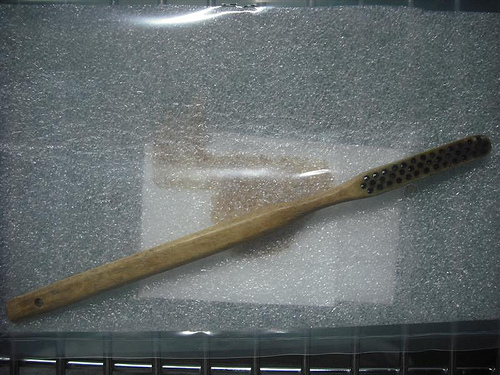
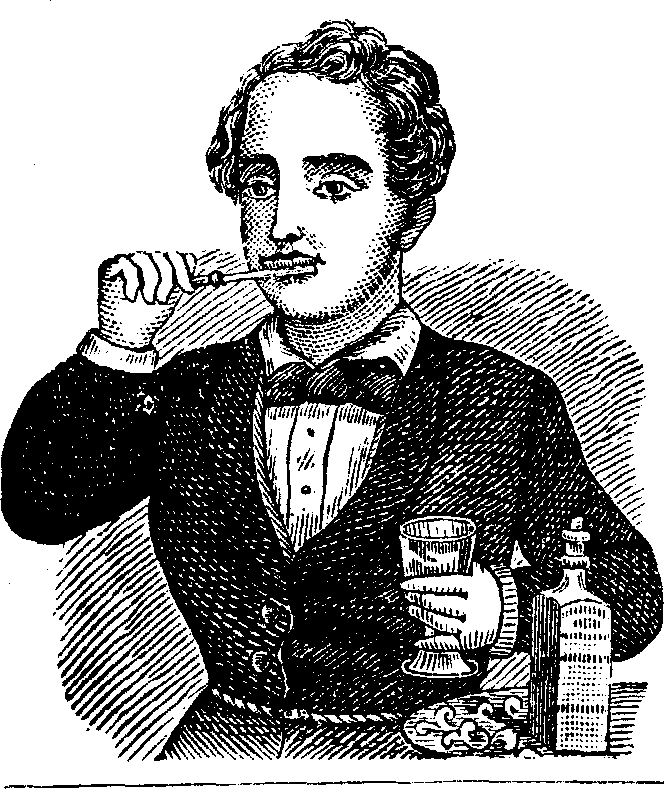
Let’s not assume that brushing the teeth then was just the same as it is today. For instance, these days, most of us are able to look after our teeth quite well with the aid of modern dentistry and all the products on the market. However, in Victorian times there was not such a lot of choice. Toothbrushes looked like the ones we use now; although the handles would have been made of bone or wood and the bristles would have been of horse or pony hair.
Fancy cleaning your teeth?
Soot and charcoal
Toothpaste was referred to then as dentifrice; many people cleaned their teeth with a little salt or soot though. However, your character could go to the pharmacy or chemist and buy commercial dentifrice. These were mostly coloured abrasives which would polish the teeth. In these pastes you would find that it was the powdered chalk and cuttlefish which were the ingredients which would make your pearly whites sparkle; although soot and charcoal was also used in some pastes.
To make your character’s mouth smell medicated, camphor, myrrh or burnt laurel would be added. These would linger in the mouth to make his, or her, breath inoffensive. The camphor and alum may also have had a small antibacterial effect too.
Powdered coral and dragon’s blood were added so that gums would appear pink and healthy. These days we expect toothpaste to be white to reflect the colour of our teeth but in the Victorian era it was supposed to emphasize what good condition their gums were in. All of these things can be woven in to add detail and keep your characters on the move.
Looking good!
Incidentally, when chalk was added to some brands of dentifrice, it was the same material which folks would use to scrub out their sinks and bath tubs with. The cuttlefish in the paste was found washed up on the beaches. Today we use it in budgerigar feed.
Do you want to write a crime novel but don’t have the confidence? Don’t worry, you could always base it on a real life crime. If you are worried about being sued by the people involved, the trick is to set it in the past; this way your book will appeal to lovers of both crime and historical fiction.
To demonstrate what we mean, we offer a springboard to get you started. This is worth reading even if you don’t intend to write anything.
Your springboard is the Poison Ring in Paris in 1673. During that year of Louis XIV’s reign, two priests told the King that a number of penitents had asked for absolution after murdering their spouses. Obviously, names could not be given but the Chief of Police, Nicholas de la Reynie was put onto the case. He found out that a ring of fortune tellers were supplying what were called ‘succession powders’, in other words poisons, so that people could get rid of inconvenient partners.
What is going on in the minds’ of those in Louis XIV’s court?
International poisons ring
The problem for De la Reynie was that he had no names. However, he kept sniffing the air and after four years he managed to fit together clues which led him to understand that there was an international poisons ring. It was similar to the drugs and paedophile rings which go on these days. Even more surprisingly, De la Reynie discovered that the ring was headed by men of influence.
Eventually, De la Reynie got the lead he had been waiting for. The fortune teller, Marie Bosse said that she was going to retire after she had arranged three more poisonings. A disguised policewoman consulted Bosse on how she could get rid of her spouse and an arrest was made when Bosse sold the poison to her. Her house was raided and many poisons were found there. Bosse, her husband and two sons were arrested. La Vigoreux, another fortune seller who shared a communal bed with the family, was also arrested.
A later burning alive execution.
After they were interrogated, it was revealed that up to half of the aristocracy were trying to poison one another. The king was shocked but even more so when he discovered that two ladies were planning to get rid of one of his own mistresses, Louise de la Valliere. Marie Bosse was burned alive.
So here we have it – a setting, a plot, main characters and even a detective. What are you waiting for?Happy writing.
Loony Literature is all about literature. We write books and plays, make video clips about them and encourage others to read, write, act and film more.





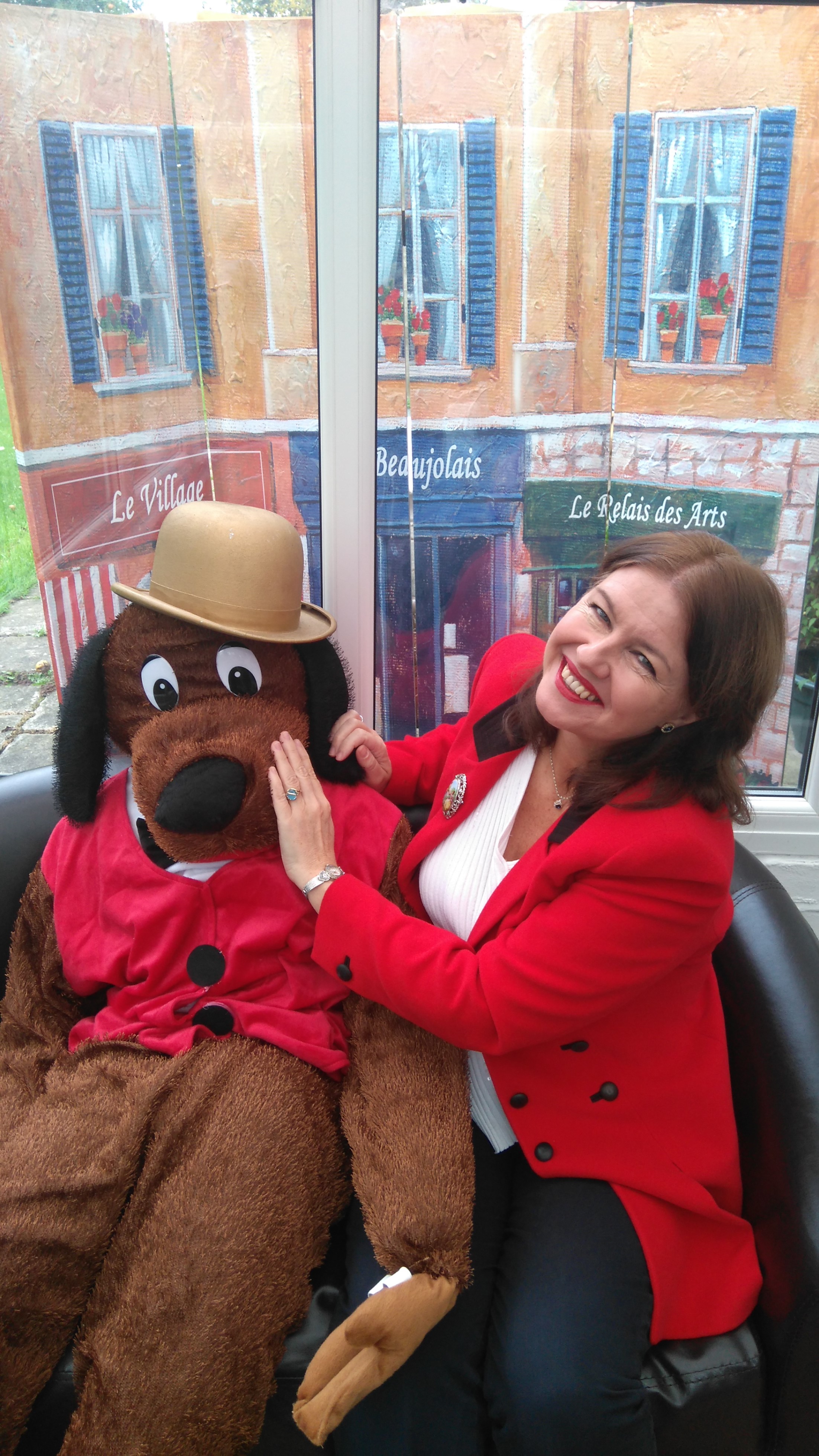







 Michelle Barber and Mystery