Creative Writing – A Great Character Needs Attitude

Here at Loony Literature, we love distinctive characters and feel that an important part of characterization is attitude – theirs not yours. So how can we encapsulate this in our writing?

Let’s imagine that you want to create a middle class, Victorian, married woman who has a family. What type of attitude might she have about her main occupation of being a home maker? One of the easiest ways to do this is to read what she might have read.

Make the most of free resources

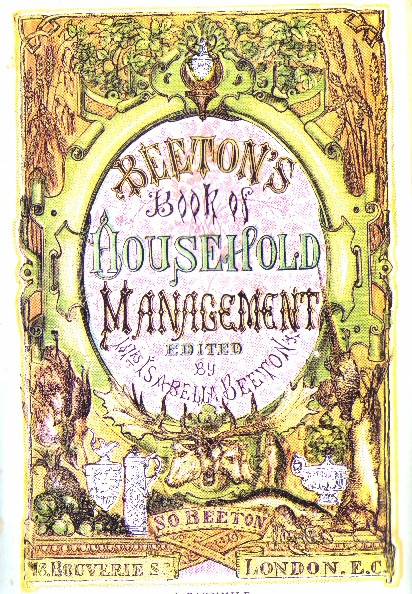
A good place to start in this particular case is with The Book of Household Management by Mrs Beeton which can be downloaded for free if you follow this link. Mrs Beeton is probably the most famous British cookery writer in British history. She lived in the 19th century and gave advice on most things to do with a woman’s life. If you need to know how to deal with servants – it’s in there.

This is full of interesting information for the writer .

This is full of interesting information for the writer .

Lying in opium dens smoking

For instance, Mrs Beeton suggested that if you have young people still living at home, agreeable pastimes should be promoted. She stressed that homes should be comfortable, full of happiness and offer a great source of amusement. If the young folks cannot find pleasure at home they will seek it elsewhere. She pointed out to parents that they should make it a domestic policy that their children should feel that ‘home is the happiest place in the world’. We can imagine Victorian ladies worrying that if they do not come up with the domestic goods, they would be to blame for their children lying in opium dens smoking funny looking pipes. Some things never change.

Worry not because Mrs Beeton does actually explain how this can be done. The mother can gather the girls of the household around her to enjoy a couple of hours of light or fancy needlework. If they want to have a real rip roaring time, they can always throw in a game of chess or backgammon.

Mrs Beeton also suggested that feminine members of the family like to sit around and listen to amusing publications being read out loud. However, if the whole family is joining in the listening it must be polite literature which is on offer – no Frankenstein or Dracula then.

Mm - Guess who is keeping a happy home?

Mm – Guess who is keeping a happy home?

Books like this are a goldmine of information for the writer and will inspire you endlessly. Even more importantly, they will give you an excellent awareness of attitude which is all important when creating character. Happy writing.

Leave a comment

Filed under Creative Writing, History, Inspiration and Us

Writing Ideas – Using Non Fiction to Produce Fiction

A Nostalgic Setting

For any one reading our regular writing springboards who is doubtful that this method produces results, take a look at ITV’s sublime television series, Home Fires.  Incidentally, if you want something that offers a nostalgic setting, edge of the seat conflict, skilled acting and is truthful and exquisitely tasteful, then this is for you.

Two of my favourite actors, Francesca Annis and Samantha Bond.

Two of my favourite actors, Francesca Annis and Samantha Bond.

Set in Cheshire during World War II, the main arena is the Women’s Institute and when I say the word arena, I mean it. Don’t be put off by the words ‘jam making’ because that is actually the water that binds all the other ingredients together. This superb drama is about war, domestic violence and the politics which rage in all communities and institutes.

Back to how historical information can be the perfect springboard. Home Fires was inspired by the book Jam Busters by Julie Summers. Summers’ research through archives and interviews investigates how the Women’s Institute helped rural Britain during World War II with all the jam that they made.  So if reading stuff like that produces such top rate television then you’d better get reading and writing. Some of the best women’s magazines also publish historical fiction so that is a good market to look into too.

A great insight into the lives of women during World War II.

A great insight into the lives of women during World War II.

So without any further ado, let’s springboard a truth.

If we go back to World War I many young men were killed and then to add insult to injury the Spanish Flu epidemic caused the death of so many others that there was actually a shortage of marriageable men at that time. Catching onto this fact, entrepreneurs believed that they could tell women that if they did not look good they would not get a man. Does this sound familiar?

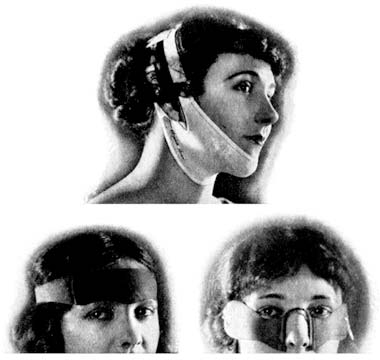
Have you got a double chin

We only have to scour the ladies’ magazines for the first half of the 1920s to see how filled they were with advertisements for body treatments and face creams. At that time, colour illustrations were often only on the front cover of the magazine and so copy writers had to sell their booty by painting pictures with words. The adverts were basically an aggressive attack on women to undermine their confidence. Women would open a magazine to see ‘have you got a double chin?’ looming out at them.

Could you wear a chin strap?

Could you wear a chin strap?

In those days, they did not seem to offer make-up to conceal and enhance the best features of a woman instead they suggested prevention or in some cases what can only be described as physical pain. For instance, you would put moisturiser on your face and then attach the Ganesh chin strap to your head and sleep in it – no wonder we no longer hear of this method of keeping wrinkles at bay.

Could you create a character that uses these methods to add flavour to your story?  Whatever you come up with – happy writing.

2 Comments

Filed under Creative Writing, Inspiration and Us

Writing – Make the Past Your Inspiration and Get Pounding that Keyboard

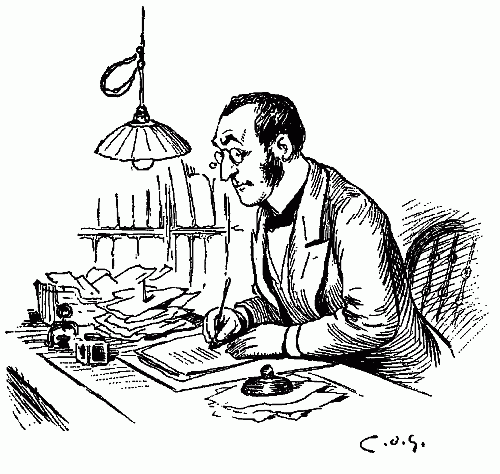
Writing is therapeutic

Stuck for an idea? Well you are in the right place. Here at Loony Literature we are on a mission to make peoples’ lives better by encouraging them to do something creative. We know that it’s not always easy with all the problems that life throws at us but that it why it is even more important to get stuck in – being creative will help you through the hard times.

If you want to write a short story, a play or an article, one of the easiest ways to get an interesting idea is to embrace the past. All you have to do is scroll the web or visit the library and then read about it, before you know where you are, you will be scribbling ideas all over your notepad with an extraordinary flourish.

Getting on with it.

Getting on with it.

Use superstition as a source

To whittle it down, why not look into superstitions of the past and see if anything gets your fingers itching? However, to get you started, we have got a springboard for a murder set in the Tudor period. We hope that it helps.

Superstitions like avoiding walking under ladders have been around for a long time. In fact, if we travel back in time to the Tudor period, it is interesting to see just how superstitious folks were then. Proof of this happened just under five hundred years ago with Sir George Vernon who owned Haddon Hall. Ruling the surrounding area with a stern severity, he dealt with cases of crime with an iron attitude.

For instance, when a pedlar was found murdered, Sir George Vernon investigated. Hawking his goods about the neighbourhood the previous day, the pedlar was spotted entering a cottage in the evening and was not seen alive again. When Sir George found this out, he ordered that the body should be taken to Haddon Hall and laid out there.

Last seen alive

The man who lived in the cottage where the pedlar had last been seen alive was then ordered to go to Haddon Hall. When he arrived, Sir George questioned him but the fellow said that he had no knowledge of the pedlar. His nibs then snatched the sheet from over the dead man and told everyone that they had to touch him. Yikes! In those days, there would be great superstition over doing that if you were the murderer.

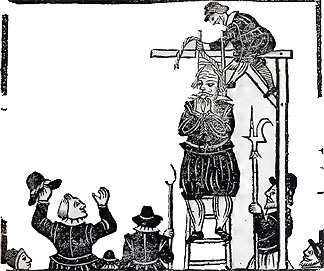
Gruesome Times

Gruesome Times

Shrinking back, the pedlar would not put his hands on the body. Sprinting as fast as his legs would carry him out of the hall, he disappeared from sight. Deciding that his suspicions had been right, George ordered his men to pursue the cottager on horseback and hang him on the spot. They finally caught up with him in a field and followed his lordships orders. Sir George had to travel to London to explain himself in court but no further steps were taken.

Happy writing.

Leave a comment

Filed under Creative Writing, Inspiration and Us, The Peculiar Past

Writing Cosy Crime – Use a Bizarre Club as a Setting

Get Writing

Here at Loony Literature, we have eclectic tastes and one of the genres which we adore is cosy crime. This means that we want more people getting stuck in and writing some wonderful tales. If you need a springboard to get you started, think about setting the crime in a club but not just an everyday club, use something different. We’ve found a few that you may be interested in.

On the 15th January 1904, a newspaper advertisement asked for new members for a club in Fribourg in Switzerland. The club was the Bald Headed Club and its rules were that the members should meet every month to eat ham and listen to music.

Invite the Public Executioner

In April 1928, the Crime Club used to meet in London three times a year to discuss criminology. It was a rule that nothing which was discussed within the club was repeated outside those walls. The club which started off with six eventually increased to forty members. One of the members once suggested that the public executioner should be invited to one of the club’s dinners but he could not get anyone to second him so the idea was dropped.

Apparently, the Thirteen Club gathered so that its members could defy superstitions and would spend the evening walking under ladders and putting up umbrellas whilst indoors.

Some believe that the raven is unlucky.

Some believe that the raven is unlucky.

Meanwhile, The Fatman’s Club in Paris enjoyed its banquets. No one was eligible for membership under seventeen stone. One man proudly polished off half a dozen chickens and a barrel of wine at one sitting and it won him a prize of thousands of francs.

Happy writing.

Leave a comment

Filed under Creative Writing, Inspiration and Us, The Peculiar Past

Writing Short Stories – Using Gruesome Keepsakes as a Springboard

Here at Loony Literature, we are always looking for springboards to get folks writing. So if you are thinking of writing a short story, you may be interested to know that buying a keepsake when you visited somewhere or experienced something is not a new thing. However, in the 19th century some of the keepsakes which were purchased were rather gruesome to say the least. In essence, they were real short story fodder.

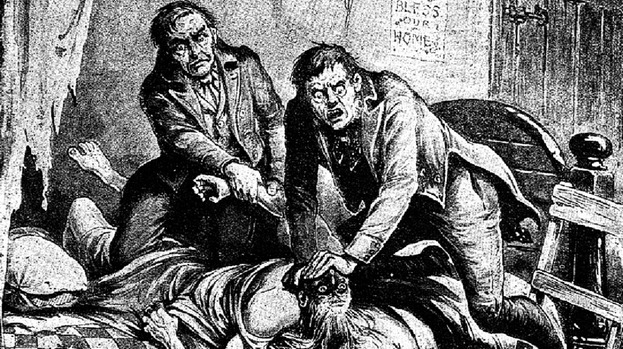
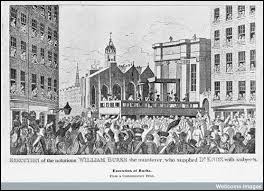
Murder Most Horrid.

Murder Most Horrid.

For instance, when Burke, of the famous Hare and Burke duo of body snatchers, was to be executed, 20,000 people cheered as the scaffold was built. When Burke appeared, the mob went wild screaming what they would personally like to do to him. Every time Burke convulsed as his body was hanged, the crowd raised an even louder roar, a sort of cheer because he was suffering so much.

A wallet was made from his scalp

When Burke’s body was removed from the scaffold, souvenir hunters descended like scavengers grabbing at shavings from the coffin or pieces of the rope. If this seems strange, it was quite normal back then. The rope which hanged Burke would have been sold off in inches because so many people wanted a keepsake of the event. In fact, a wallet was made from Burke’s scalp and is now in the History of Surgery Museum in Edinburgh’s Royal College of Surgeons.

A Grisly Day Out.

A Grisly Day Out.

After he had been cut down, Burke’s body was taken to an anatomy theatre which was ironic as that was where he had taken the bodies of the folks he had murdered so that he could get money for them. A cast was taken of Burke’s head and then a dissection was performed. Outside people fought to get inside to taste a piece of the action. The next day, there was a display of the body and visitors could file past it from ten in the morning until dusk. It is believed that as many as 30,000 people turned up to see Burke’s body.

Come on, this is asking for you to write a horror story.

Happy writing.

6 Comments

Filed under Creative Writing, History, The Peculiar Past

Writing Historical Fiction – Getting to Work in 19th Century London

It Wasn’t Easy

Here at Loony Literature, we love to get folks writing.

Writing historical fiction is a great way to learn something and transport yourself to another time and place. Your springboard for today is to imagine that you have an accident on the way to work. The only difference is that it happens in 19th century London. Think about who your character might be and what are the consequences of the accident are – do you get involved with someone you might never have met before? This could be to do with a romance or a crime.

London Bridge in the 19th century.

London Bridge in the 19th century.

To help you get started, we’ve compiled something for you to think about. For instance, you may be interested to know that if you had to travel across London in the 19th century, it was hard work even back then.

If you had an excellent job, you would navigate your way to work on horseback. However, this was indeed a costly business. We complain about the cost of parking these days but if you lived then and the horse was your mode of transport, you had to feed and stable the horse at home and also at a place which was near to where you worked. City livery rates were so exorbitant that many would ride half way on horseback and then the rest of the journey to work would be conducted by boat.

Getting Across The Thames

Of course, the Thames was a sort of highway for London but at the start of the 19th century there were only actually three fixed points to get across it. There was London Bridge which had been a crossing of some sort since Roman times or there was Blackfriars Bridge which was built in 1769 or Westminster Bridge which first came into being in 1750.

This meant that if you needed to travel across the river to get to work you would probably have used one of the 3,000 wherries or small boats which were available for hire. We can read about characters in books being rowed across the Thames, such as the dastardly Quilp in The Old Curiosity Shop by Charles Dickens.

Happy writing.

7 Comments

Filed under Creative Writing, History, Inspiration and Us

Writing Historical Fiction – A Pair of Stockings as a Springboard

Get Writing

Here at Loony Literature, we try to get folks to have a go at something  they might not have done before. As both of us are history bonkers, we want more of you to try writing historical pieces. They don’t have to be massive literary tomes, for instance, you could try a short story or even a play.

Readers of historical pieces love details and enjoy learning something as well as being transported in time. The springboard for this piece is a pair of stockings. So you need to think about who did the stockings belong to? Perhaps they were found in the butler’s pantry or if you are a crime writer they might have been used to strangle someone.

What story does this item of clothing tell you?

What story does this item of clothing tell you?

To help you along, we’ve compiled some working knowledge on stockings. You may be interested to know that during the Victorian period, ladies all wore stockings as tights were a 20th century invention. The Victorian stockings were made of cotton, wool or silk and available in a wide range of colours.

At the start of the 1800s, white was all the rage but after 1850 brightly dyed and patterned stockings were available. These were enjoyed by the young and also anyone who wanted something different. They were available in tartan, spotted and checked amongst others designs. This is surprising as it is easy to presume that they would all have been either white or black for the Victorians.

Black stockings

However, as the century went on, the black stockings became more widespread. This demonstrates how symbolic clothes can be. Black stockings in the Victorian period were viewed as conservative whereas black stockings these days signify sexiness.

Wool stockings were often the choice because they were the warmest and the most reasonably priced option. Silk stockings were basically only for the wealthy as they were so expensive. Furthermore, if they laddered, they were difficult to darn which made it time consuming. Only a woman with a personal maid would really have the time to commit to darning silk stockings. Well, it wouldn’t be her own time which she was committing to the task but her maid’s.

These days, suspenders are considered the heights of sexiness by some and again they are a Victorian invention. Women began to hold their stockings up with suspenders in the 1880s. Up until that time, however, stockings were held up by garters which fastened around the leg just above the knee. There was a health risk with wearing garters like that. Varicose veins could start if the garters were too tight and stopped proper circulation.

Happy writing.

3 Comments

Filed under Creative Writing, History, Inspiration and Us

Writing Historical Fiction – Sizing Your Codpiece

Here at Loony Literature, we hope to inspire you to share our creative passions and interests. For instance, working on historical fiction never fails to cause a gargantuan giggle as the research both delights and shocks us. What is more, if any of us, you included, use these delicious details in our writing they will make it sparkle for the reader. So if you write about the Tudors, make sure that you don’t get caught out by having your hero with a wrongly sized cod piece. Flabby fiction will ruin your flow!

Henry VIII codpiece

Fashion for men, changed drastically from when Henry VIII was on the throne to when his daughter ruled the land. The reason, of course, was all to do with symbolism. When Henry was in power, he had to show everyone that he was not just a man but a great giant god of a man. In those days, manhood meant virility and what better way to signal to the world that you are a sex superman than by wearing a colossal protruding cod piece. In the world of the Virgin Queen, the penis could not equate to power so cod pieces positively shrivelled in size at Elizabeth’s court.

Women had to be careful what they displayed during Elizabeth’s reign. Unless you were a vulgar washerwoman at the bottom of the social pile you would never reveal your bare arms or legs in public. However, as long as you were not married you could parade your breasts like Farage does his pint of beer. Apparently, age did not come into it either. If you were unmarried and elderly, you could still wear a dress which let it all hang out. In fact, we know that Elizabeth liked to display her breasts a lot. This was so much so that it was documented when different ambassadors visited and described the royal boobs.

Happy writing.

4 Comments

Filed under Creative Writing, History, Inspiration and Us, The Peculiar Past

Story Ideas To Get You Writing – Getting Married in the Buff!

Stuck for something to write about? Here at Loony Literature, we are pure suckers for history so when we come across something which we think might be a good springboard to get you folks writing, we will shout about it. Even if this doesn’t make you start writing frantically, it will inform and entertain you – hopefully.

To write or not to write.

To write or not to write.

In the 18th century ‘smock weddings’ were a type of ceremony. A ‘smock wedding’ would see a bride getting married in the nude or barefoot and wearing only a chemise or underskirt, as we call them these days. The idea was that if she brought no clothes or property to the marriage, her new husband to be was not liable for any of the debts of her past life.

The smock wedding was particularly useful for a widowed woman whose husband had died leaving a lot of debts. We know because of a newspaper report in September 1775 that a Mr Richard Elcock who was bricklayer married Mrs Judith Redding. It seems that so Mr Elcock would not be liable for any of the debts that Mrs Redding might have been left with from an earlier marriage, she went into one of the pews in the church and stripped off everything except her slip.

A few years earlier, at Saint Michael’s Church in Ashton under Lyne, Nathaniel Eller married the widow Hibbert. Both of them were around fifty years of age. The widow went through the ceremony with her hair tied behind with horse hair and wearing only a shift so that her new husband would not have to pay off any of her former husband’s debts.

In December 1797, several newspapers reported from St Philips parish church in Birmingham that the bride wore nothing. She was a woman of wealth and property but she was marrying a debt ridden husband and she believed that getting married in the nude would prevent her new husband’s creditors from seizing her property. She was not the only lady to be married in that fashion. It seems that some women would turn up to church in a cloak and nothing else. With a flourish they would remove the cloak and the ceremony would begin.

Happy writing.


2 Comments

Filed under Creative Writing, History, The Peculiar Past

Textual or Sexual?

English: Portrait of Virginia Woolf

English: Portrait of Virginia Woolf (Photo credit: Wikipedia)

One of my great interests in reading matter is how desire is handled.  After the huge sales of “Fifty Shades of Grey”, I had begun to wonder if readers needed their sex spelled out more nowadays, if so, does that mean that many readers are missing out on playful texts as titillating as Orlando by Virginia Woolf?  In this written piece, I hope to persuade readers to interact with text such as “Orlando” for a deeper and potentially more sexually satisfying read.

I have taken chapter 3 from Orlando (Great Classic Library, 1994) to demonstrate that often it is not what is said that conjures up fantasy but what is not said.  Also, I use the constant ‘she’ but this refers to both sexes, it is simply to keep the text tidy.

Cover of "Orlando"

Orlando by Virginia Woolf with the talented Tilda Swinton on the cover. She played Orlando in the film.

If we can imagine a courtship between reader and text, then it becomes obvious that the text (Orlando) is using details to entice the reader as love object.  Whilst the reader is consumed with the desire to see and know the text, it encourages fevered requests for knowledge by constant teasing.  It attempts to keep the reader interested by manipulative and provocative tantalisation which never allows the desire for textual knowledge to be fulfilled.  Subsequently the reader continues to endeavour to explore and undress the body of the text.  In other words, the text uses a playful strategy which depicts an innocence by using understated sexuality to allure and provoke the reader into the commitment of interpretation.  The signals are there, the reader merely needs to be seduced.

The text displays constant symptoms of needing the reader to become its love object.  Consequently, in order to overcome this, it must attain to interest its love object; therefore it is only by seducing the reader into the position of desiring to know the text that it can attempt to fulfill the desire for unattainable completion.  To initiate interest, the text suggests that it will become love slave to  the reader’s fantasies but only if the reader will respond by opening her psychic space.


“There was a hole in the manuscript big enough to put your finger through …. but it has been necessary to speculate, to surmise and even to use the imagination.” (page 54)


The language cleverly entices the reader to visualize that which is being suggested.  The beckoning finger attempts to coax the reader into penetrating the written sign and being seduced into allowing her repressed fantasy to filter through.  It invites the reader into its existence with a manipulative proposition which offers a text lacking in language, subtly suggesting that the reader fills in the gap for herself.  Subsequently, the text is pertaining to reach unity with the reader by a language of denial being impregnated by the reader completing the gaps.  However, the fantasy must remain fragmented as the text’s constant denial of knowledge defies fixed interpretation.

As the suggestive finger tempts the reader, so the text uses thresholds to tease and control the reader’s access.  Windows are used to allow a connived amount of voyeurism.


“The windows of the Embassy brilliantly illuminated.  Again details are lacking.” (page 57)


Windows are used to set a scene to draw the reader in.  They are used as a controlled promise of an insight into the text.  The text manipulates a sense of deviant excitement as the reader anticipates the fantasy of voyeur as illicit views through the windows suggest that the reader should not be in attendance, that she will be witness to a scene which is too prurient to be written about.  However, the text denies the details the reader is hoping for; in essence, the text leaves spaces for the reader to mould it into whatever is fantasised about.

As opened windows are used to lure the reader into the ranks of hopeful voyeur, so the closing of doors is a carefully operated device which causes the reader’s mind to engage itself in a frenzied thought process which hungers for knowledge of the text.


“The Ambassador was seen to go to his room, still wearing the insignia of his rank, and shut the door.  Some say he locked it, which was against his custom.” (page 59)


The narrative content of the text draws the reader in by locking her out.  The concept of the text as love slave is being played as the reader is only provided with alleged details.  The text essentially offers the reader the chance to create her own fantasy within the text.  In other words, the text is again using denial of details as a promise of adaption in order to satisfy the reader’s fantasy.

English: Entrance to Freuds consulting room

English: Entrance to Freuds consulting room (Photo credit: Wikipedia)

In a never ending craving to complete the cycle of lack and desire the text successfully employs the device of ellipsis to create more gaps to encourage the reader to allow her repressed fantasies to surface.  The use of ellipsis suggests events which are too shocking to mention.


“Wondrous… utterly beyond description… gold plates…candelabras…negroes in plush breeches…” (page 58) ( please note that I do not agree with racist labels and I am not suggesting that Virginia was racist either; I am merely quoting the text)


The language which is used paints a decadence to indicate indulgence; to add ellipsis creates a subjacent meaning for the reader which arouses the most dormant of fantasies.  Fundamentally, the text works the reader’s mind.  The lack of language in the text encourages the reader to search the decadent language which is present for signs which indicate what the reader is hoping to locate.  As ellipsis in the text intimates a joining of language and absent language, the marriage must result in a lack desire interchange which can never be fulfilled as both are always acting as chameleons in search of each other.

The text uses Orlando as bait for the reader’s desires.  The sexual titillation concerning Orlando’s body is ambivalent.  The denial of details can be interpreted as writing which is vaguely aware of sexuality but unaware of how to work it; similarly it can be interpreted as the love object who attempts to lure the reader by a provocative indication of sexuality.  The interpretation will be open to the reader’s own exploration of the text but it is ultimately a stimulation used to attempt satiation of the reader’s psychic erotic space.


“Going indoors again, withdrew to his bath.  An hour later, properly scented, curled and anointed.” (page 54)


The reader is denied access to the bathroom in order to fantasise about Orlando having his body prepared for the events of the day.  The connotations of the above quotations are erotic by denial of detail.  It is probable that nudity and genital washing is involved, but it is purposely ambiguous as to whether he is vainly paying homage to his body himself or whether another is used to cleanse and cream the crevices of the protagonist’s person.  The innuendo is perverse as the use of the two sentences allows the reader to act as voyeur (which can be regarded as a perverse act in itself) to the most personal erotic bathroom fantasies desired.

If the text entices the reader with suggestions of being voyeur to Orlando’s personal moments, then to have Orlando in position of ultimately any fantasy is the pinnacle of invitations for the reader.


“And still Orlando slept.  Morning and evening they watched him.” (page 60)


The text deigns to give details as to Orlando’s long sleep but using sleep is an indication of death which can be an interpretation of orgasm.  According to Sigmund Freud in “The Interpretation of Dreams” sleep also is a signal for repressed fantasies being released in the form of dream.  Therefore the written sign becomes cohesive with the code of sexuality which encourages the reader to embark upon a scenario of being the mistress of Orlando’s body.  In actuality, the text as love slave is seducing the reader into being the love object by stimulating the fantasy of control for Orlando’s sleeping body.

Finally, as Orlando undergoes metamorphosis from man to woman:


“THE SOUND OF TRUMPETS died away and Orlando stood stark naked.  No human being, since the world began has ever looked more ravishing.  His form combined in one the strength of a man and a woman’s grace.” (page 62)


The reader is denied details of Orlando’s perfect form except the fact that he/she is ravishing.  This implies that the text is again using Orlando to capture the reader as love object.  In other words, Orlando is there to be moulded and created into the reader’s version of that which would be desirable, a Frankenstein’s monster made in the form of beauty to the eye of the reader.  The denial of details are cleverly used to incorporate whatever the reader desires in the way of physical features.  Therefore, as details of Orlando are lacking, the reader will write the body of Orlando herself to portray her own fantasy of loveliness.  Subsequently, by continual denial of detail to the reader, the text ensures in a controlled and intelligent manner that the reader commits an interest to it by being whatever she desires.

In conclusion, with a text as fluid as Orlando, we can write our own sexual fantasies, in essence, this means that the text can be read as a sexual fantasy or simply as a fine story; fundamentally, it adapts to what its love object – you the reader wants – can this be said about text like “Fifty Shades of Grey?”

 

33 Comments

Filed under Literary Criticism, Reading